
Guide · Basic driving exercises
Which basic driving tasks are included in the category B test, how are they assessed, and how do you practise them properly?
Parking in front of an audience, turning in a narrow street, an emergency stop on command – the basic driving tasks are the part of the practical test that feels most like a “performance”. Yet they are the most predictable part of the test of all: set tasks, clear grading rules and a built-in second chance. Here is the complete overview for Category B.
- What basic riding exercises are – and the most important rule first
- Parallel parking in reverse: the ultimate test
- Angled parking: forward or reverse into the bay
- Turning round: the three-point turn
- The emergency stop: braking really hard just once
- When do the basic driving tasks come up in the test?
- How to practice the basic driving exercises correctly
- The most common mistakes – and how to fix them
- Frequently asked questions about the basic driving manoeuvres
- Conclusion: The most predictable part of the whole exam
What basic riding exercises are – and the most important rule first
The basic driving tasks check whether you have control over the vehicle yourself – Shunting, braking, precise driving at low speed. In the category B practical test, you will drive three tasks: one reversing task, a an additional task to be chosen by the examiner (including parallel or bay parking, turning round) and always the emergency braking. And the rule that hardly anyone knows, which takes the fear out of it more than any tip: Each basic driving manoeuvre may be repeated once. A failed first attempt at parking is just a step along the way – not a verdict.
Parallel parking in reverse: the ultimate test
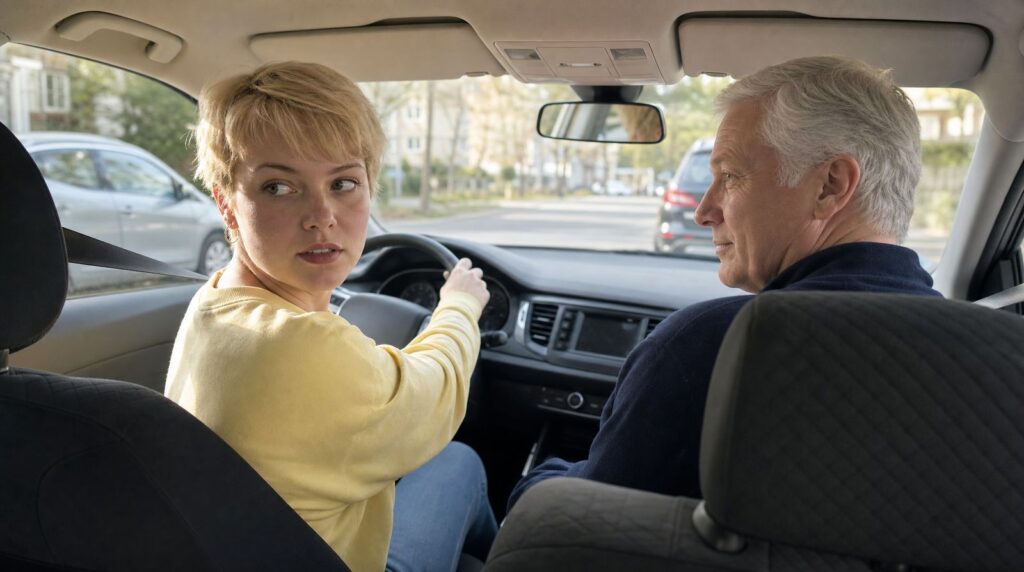
Reversing into a parking space at the kerb – the task that causes the most dread and holds the simplest truth: it is purely datum point technique. Your driving instructor will teach you fixed reference points (mirrors, window edges, markings on the vehicle) against which you can gauge your steering angle and stopping points – using the same sequence every time. Important for the assessment: A walking pace is preferred, there is no minimum speed limit and no time limit; Proofreads are permitted; and half the battle is Traffic monitoring – Anyone who parks with perfect technique but fails to look over their shoulder or check their surroundings has failed the task. It is only considered a failure if there is significant contact with the kerb or if the vehicle ends up at an angle in the traffic lane.
Angled parking: forward or reverse into the bay
The multi-storey car park task: park into a marked perpendicular space – either forwards or backwards, depending on the instructions. Despite feeling more difficult, reversing is technically the easier option (smaller turning circle, better control). The assessment is the same as for parallel parking: final position within the markings, controlled speed, and constant awareness of the surroundings. Here too, adjusting your position slightly is permitted.
Turning round: the three-point turn
Turning in a narrow street, classically in three moves (forward – back – forward). The mistake that costs the most points here: It's about not the number of trains – five clean moves with traffic observation are better than three frantic ones. You'll be assessed on whether you check traffic in both directions before every change of direction and keep the vehicle under control at all times. Time pressure only exists in the mind.
The emergency stop: braking really hard just once
From about 30 km/h at the examiner's instruction, brake to a stop as quickly and forcefully as possible. The only real mistake here is – surprise – braking too hesitantly: Gentle “comfort braking” is not permitted, as the exercise simulates an emergency situation. So: press the brake pedal fully (in a manual car, press the clutch at the same time to prevent the engine from stalling), hold the steering wheel firmly, and keep your eyes straight ahead. Modern driving school cars have ABS – the vehicle remains manoeuvrable even under maximum braking; you can’t go wrong, except by braking too lightly.
When do the basic driving tasks come up in the test?
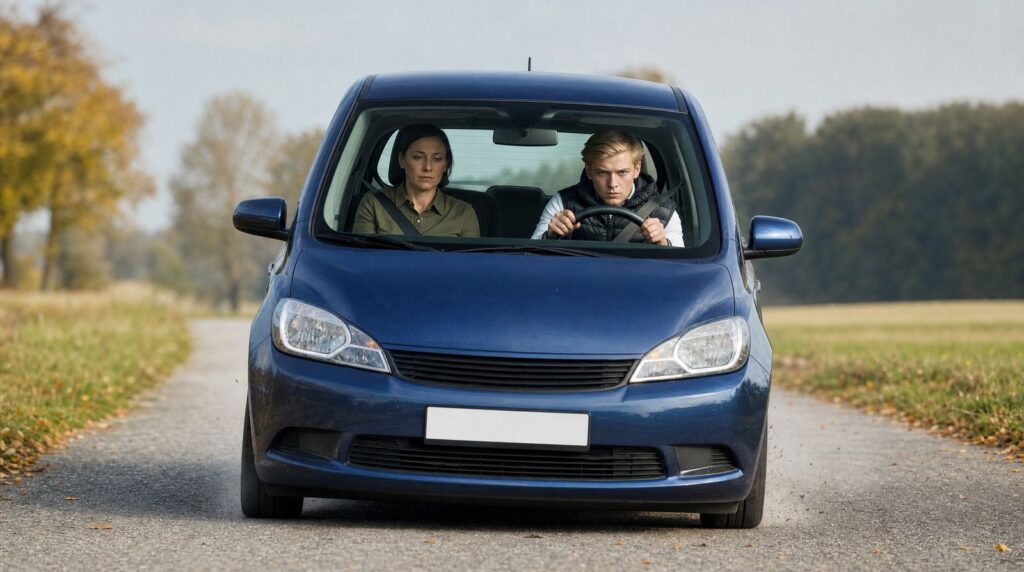
Contrary to what many people think, there is no set “basic driving tasks” section at the start: the examiner puts the tasks together into the test drive, wherever appropriate – parking in a suitable space in a residential area, performing an emergency stop on a quiet, clear road, or reversing in a suitable side street. Each task is announced clearly and in good time (“Reverse into the space behind the blue car”), and you’re allowed a quick look at the situation before you start. The good thing about this approach is that it feels less like a performance than it does in your imagination – you simply drive, and every now and then a manoeuvring task comes up.
By the way: The dreaded Hill start This is not a separate basic driving task – it is assessed as part of normal driving when the situation arises. Using the handbrake is a permitted technique in this context, and a brief roll-back that is safely controlled does not constitute grounds for failure.
How to practice the basic driving exercises correctly
- Reference points rather than gut feeling: Ask the instructor to show you every reference point on the driving school car and go through the procedures out loud with them – if you can explain it, you can do it.
- First calm, then real: The exercises are first set up in a quiet environment and then move to real parking spaces and streets – right where the test takes place.
- Repeat until boring: A basic driving manoeuvre is mastered when you can perform it several times in a row without having to think ABOUT whether it will succeed – only how cleanly. Boredom is the quality seal here, which survives exam nerves.
- Automate traffic monitoring: Blind spot check and all-round check before every shunting move – exaggeratedly clear during practice so that it is second nature in the test itself (and the examiner sees it).
The most common mistakes – and how to fix them
- Shunting too fast: Almost all parking problems are caused by speed. Remedy: clutch at the biting point or creep mode, stop and think if necessary – coming to a standstill is allowed.
- Focusing on the obstacle instead of the path: Stare at the kerb and you'll hit it. Look where you want the car to go.
- Traffic observation forgotten: the actual core of the evaluation – technique without circumspection is a failed task, circumspection with a corrective move is a successful one.
- Give up after a blunder: You have one free repetition per task – feel free to use it with focus, instead of dwelling on it. You can read how the assessment system works overall in the guide Fault in the practical test.
Frequently asked questions about the basic driving manoeuvres
What tasks are on my exam?
The examiner decides that on the day of the test – which is why a good training course practises all variations. The only mandatory manoeuvre is the emergency stop; this is accompanied by a reversing exercise and another chosen by the examiner.
May I use the reversing camera and parking sensors?
The driving assistance systems of the test vehicle can generally be used – but they do not replace all-round observation: the examiner wants to see shoulder checks and mirror work, not just your eyes on the screen. It is best to discuss how this is handled in your specific test vehicle with your driving instructor.
How many times am I allowed to repeat a task?
Each basic driving task may be repeated once. Only repeated failure of the same task will result in failing the test.
Is there a time limit for parking?
No. Walking pace and calm, controlled manoeuvring are expressly desired – rushing is the mistake, not slowness.
Read more
Conclusion: The most predictable part of the whole exam
Fixed tasks, clear criteria, one free repeat – the basic driving manoeuvres are not a game of chance, but a craft. Anyone who learns them using reference points and practises them until they are boring takes the sting out of what feels like the hardest part of the test. The rest of test day is demystified in the guide Practical test: Tips for passing.
Where the basic driving tasks fit into the overall sequence is shown by This is how you get your driving licence. Everything about Category B training.