
Guide · Driving lessons
How many driving lessons are compulsory, how many are normal, and what determines your personal number of lessons?
Straight to the point: Our prices and the price calculator – calculate your own example →
“How many driving lessons do you need?” is probably the most frequently asked question before registration – and one of the worst answered ones. Between advertising promises (“get your driving licence in 20 hours!”) and forum panic (“60 hours – am I abnormal?”), the honest answer is almost entirely missing. Here it is: with real figures, the factors that really determine your number of lessons – and an open answer to the question that many don't dare to ask.
- The short answer is that there is no minimum number of driving lessons
- What is normal? The honest figures
- This is how your training is structured: from the first time you pull away to test readiness
- Three typical profiles – that's how differently things can turn out
- These factors determine your number of hours
- Single lesson or double lesson – and how often per week?
- The 12 special training drives at a glance
- “Yesterday went brilliantly, today nothing is working at all”
- “Is my driving instructor dragging out the lessons?” – the honest answer
- What an extra hour really costs – and what a missing one does
- Save hours – but properly
- Frequently asked questions about driving lessons
- Conclusion: Your number is the correct number
The short answer is that there is no minimum number of driving lessons
First, the most widespread misconception: There is no statutory minimum number of “normal” driving lessons. For class B, only the mandatory 12 special training drives5 cross-country drives, 4 motorway drives and 3 drives at twilight or in the dark, lasting 45 minutes each. All remaining driving lessons depend solely on your level of training (§ 5 Driving Student Training Regulations) – your driving instructor may only enter you for the test when you can pass it safely, regardless of whether that is after 15 or 45 hours.
What is normal? The honest figures
Most learner drivers in Germany need altogether between 25 and 45 driving lessons (lessons plus the 12 special training drives) – with a wide, completely normal variation in both directions. Important for your peace of mind:
- The average is not a target. Whoever needs more hours does not “fail” – they are learning. Driving is a complex perceptual and motor task, and the learning pace is as individual as skiing or playing the piano.
- Even 50 or 60 hours are not uncommon – especially in dense big-city traffic. What counts is progress, not comparison with your mate from the countryside.
- Fewer than 20 total hours managed almost exclusively by young learner drivers with prior experience (moped, scooter, lots of passenger-seat observation) and a high frequency of lessons.
Incidentally, the test statistics for the TÜV group confirm that younger learner drivers pass the practical test significantly more often than older ones – not because they are “better”, but because it’s easier to learn motor skills at 17 than at 45. If you start later: Just allow a few extra hours without getting stressed.
This is how your training is structured: from the first time you pull away to test readiness
Driving schools do not operate on intuition, but according to a proven phased structure – and anyone who knows it will also understand why the number of lessons cannot be promised as a blanket figure:
- Elementary level Controls and basic driving exercises in a quiet environment – moving off, steering, changing gear (or not, if B197), first basic driving manoeuvres. A lot is decided here: anyone who learns the basics properly will save twice as much time and effort later.
- Intermediate level: simple urban traffic, priority rules in practice, turning, roundabout.
- Power level: dense traffic, complex junctions, autonomous driving following road signs – the level of the later test.
- The 12 special training drives: Rural roads, motorway and darkness – only when your level of training makes them useful. They are not an extra hurdle, but the most educational hours of the entire training.
- Maturity level: Fine-tuning and exam simulation – complete exam procedures until they become boring. Boredom is the seal of quality here.
Every level has a learning objective, not a timetable. Exactly for this reason, “How many lessons left?” is the wrong question – the right one is: “Which level am I on, and what is missing for the next one?”
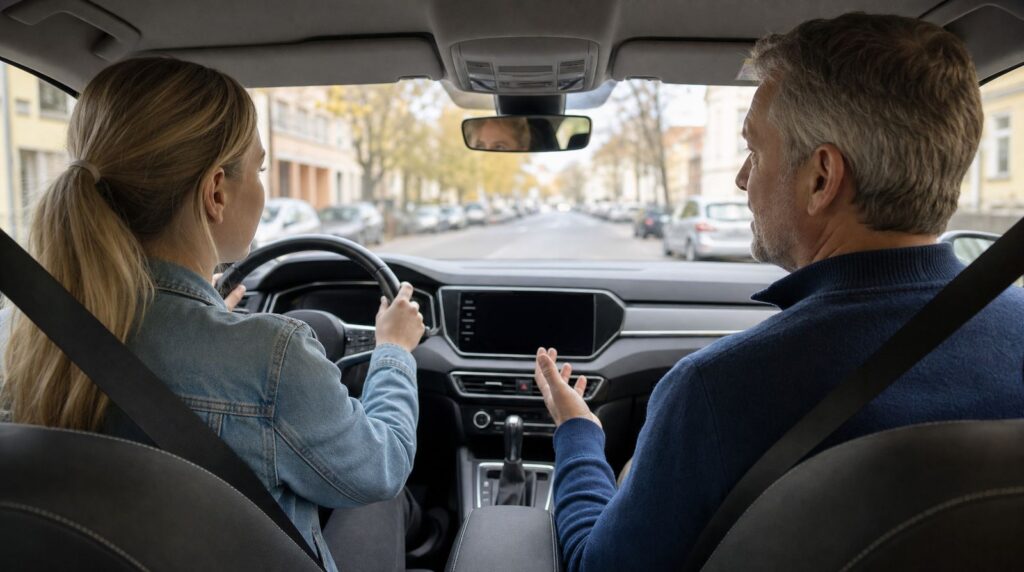
Three typical profiles – that's how differently things can turn out
Three examples from everyday driving school life (empirical values, no guarantees):
- Profile A – 17, small town, scooter experience, 2 double lessons per week: Motor skills come quickly, traffic is manageable – such pupils often reach test readiness in around 20 to 25 total hours.
- Profile B – 25, Frankfurter City transport, no previous experience, 1 session per week: more demanding environment, longer gaps between lessons – 35 to 45 total hours is realistic. Completely normal.
- Profile C – 42, career starter returning after dropping out of training, initially nervous: takes longer for the automation, experiences plateaus – 45 hours and more are not an alarm signal here, but a realistic path. In the end, Profile C drives just as safely as A and B.
These factors determine your number of hours
- Training frequency – the biggest lever: Two driving lessons a week will get you to your goal faster and with fewer total hours than one lesson every two weeks. Otherwise, you'll forget more between lessons than you build up.
- Age: The younger you are, the quicker you pick up motor skills – whereas older people bring a greater understanding of traffic and seriousness to the table.
- Previous experience: Scooter, moped, go-kart, attentive passenger – it all counts.
- City or country: Anyone who learns to drive in Frankfurt is learning in the most challenging environment – it takes more hours at the start, but afterwards you’ll be fully capable of driving in city traffic.
- Gearbox: On the automatic vehicle (keyword B197) eliminates the need to get to grips with the clutch – saving many people a noticeable number of hours as a result.
- Nervousness and pressure: Learning in a relaxed way is learning faster. Self-imposed time pressure (“I MUST be finished by the summer”) often prolongs training rather than shortening it.
Single lesson or double lesson – and how often per week?
The rule of thumb for most driving instructors: Double lessons (90 minutes) are more efficient, because the journey, settling-in period and final discussion only happen once, and you stay in the flow of the session for longer. Ideal for most people: one to two double lessons a week. Less than an hour a week will cost you money because you’ll be constantly going round in circles; more than three double lessons a week can be overwhelming for many people at the start. Towards the end of the course – when you’re nearing exam time – you’re welcome to increase the frequency.
The 12 special training drives at a glance
As these are the only parts of your practical driving training that are set out in law, here is a brief overview (45 minutes each):
| Special training drive | Number | What you’ll learn there |
|---|---|---|
| Cross-country journeys | 5 | Country roads, speed limits, overtaking, bends, right of way outside built-up areas – statistically the most challenging environment a driver will face later on |
| Motorway driving | 4 | Joining the traffic and merging, speed and distance, changing lanes at high speed, behaviour at roadworks |
| Night drives | 3 | Driving at dusk and in the dark, using lights correctly, glare, unlit road users |
These special training drives take place towards the end of your training, once your skills are up to the task – and, looking back, most learner drivers find them to be the most instructive (and most popular) sessions of the entire course. Full details of each session: Special training drives explained.
“It went really well yesterday, but today nothing’s working out at all”
A classic source of worry for driving schools – and completely normal from a neurological point of view. Motor learning does not proceed in a linear fashion, but rather in Plateaus and apparent setbacks: Your brain is restructuring its processes, and whilst that’s happening, everything feels a bit shakier than before. This isn’t a warning sign, but rather an indication that automation is currently taking place. A warning sign would be months of stagnation without any progress whatsoever – and even then, the solution is analysis (a different area of practice, a different way of explaining things), not self-deprecation.
“Is my driving instructor dragging out the lessons?” – the honest answer
Many people ask themselves this question, but hardly anyone voices it – which is why we’re doing so. First, the facts: a driving instructor who sends you into the test too early risks you failing (and jeopardises their reputation); one who artificially delays your progress risks their most important asset – trust and word-of-mouth recommendations. The business model of reputable driving schools is based on success, not endless training. Here’s how you can objectively assess where you stand:
- Exam readiness can be measured: You repeatedly drive entire routes independently – without any intervention and without the instructor having to step in to save the day. All basic driving manoeuvres (parking, reversing, emergency braking) work reliably, not just by chance. The special training drives are completed.
- Ask specifically about: “What am I still missing to be exam-ready – and what are you basing that on?” A reputable answer names specific points (“shoulder check when changing lanes only comes when prompted”) instead of vague put-offs.
- Request for a mock exam: A driving lesson that follows exactly the same format as the test. Afterwards, both sides will know where they stand.
- And what if the feeling lingers? You have the right at any time to change driving instructors within the driving school – or to a Change of driving school, under which all hours completed are recognised via a training certificate. The mere fact that this option exists keeps the market fair.
What an extra hour really costs – and what a missing one does
Let’s be honest: two or three extra practice hours will set you back a low three-figure sum. Failing the practical test costs the official exam fee, the driving school’s consultation fee, usually one or two refresher lessons – and a two- to six-week wait. So the hours you think you’ve saved are actually the most expensive of the whole course if they’re missing in the end. Conversely, the same applies: adding extra lessons when you’ve long since reached and documented exam readiness serves no purpose other than to incur costs. The trick lies in finding the right balance – and you won’t find that by relying on a gut feeling, but through an open discussion with your driving instructor and by taking a mock test. You can find the full breakdown of training costs in the guide. Driving licence costs.
Save hours – but properly
- High frequency (see above) is by far the most effective way to make savings.
- Well-rested and on time Regarding driving lessons – if you miss a lesson, you are entitled to a paid make-up lesson.
- Follow-up: Two minutes after the lesson, note down what went well and what did not – this anchors what you have learnt measurably better.
- Get the theory done at the same time, not one after the other – understanding traffic rules learnt in the classroom makes driving lessons more effective.
- Don't skimp on the final stretch: The most expensive driving lesson is the one you missed before the test. One failed attempt costs more than two extra practice lessons – you can find the full breakdown in the guide Failed – what now?
Frequently asked questions about driving lessons
Is there a legal minimum number of driving lessons?
No. The only mandatory lessons are the 12 special training drives (5 rural road, 4 motorway, 3 night). All practice lessons depend on your ability – zero practice lessons are theoretically allowed, but practically unrealistic.
How long does a driving lesson last?
A driving lesson lasts 45 minutes. Double lessons of 90 minutes are usual, which prove to be more efficient for most people.
Am I allowed to practise privately to save on driving lessons?
No – before passing the test, any driving without a driving instructor is driving without a licence, even in the supermarket car park. The exception “accompanied driving” only applies AFTER passing the test from the age of 17.
How much does a driving lesson cost?
That varies considerably by region. You can find our current prices for lessons and special training drives transparently on our Pricing page; the guide explains the total bill Driving licence costs.
Do the special training drives count towards the driving lessons?
Yes – the 12 special training drives are full driving lessons of 45 minutes each and take place at the end of the training when your skill level makes them useful. Therefore, they are in addition to your practice lessons, not piled on top as a mere formality.
Can I practise in an automatic car and still take my test in a manual?
A combination of both is possible during training – the key factor is the test vehicle: a manual gearbox test leads to an unrestricted Class B licence; an automatic gearbox test without proof of manual driving ability results in restriction 78, whilst proof of this ability leads to the B197 licence. Full details can be found in the guide B197 or manual; how the training works in practice with us is shown on the page for B197 Training.
Read more
Conclusion: Your number is the correct number
There are no mandatory hours, no target average and no reason for shame – there is only your learning path. Anyone who practises regularly, honestly asks for feedback and only takes the test when they are test-ready will end up needing exactly as many hours as they need – and will then usually pass the first time. How those hours translate into time and money is shown by our guidebooks on Driving licence duration and regarding the Cost.
All the steps of your driving licence training at a glance: This is how you get your driving licence.