
Guide · Practical Test
Useful tips for the practical driving test
How to prepare for and pass your practical driving test first time
How does the practical test work, which mistakes lead to a fail, and how do you best prepare?
The practical driving test is an exciting and nerve-wracking moment for many learner drivers. Nervousness is part of it, but with good preparation, the right strategy and some helpful tips, you can pass the practical test the first time. In this post, you will find out everything important about the test procedure, behavioural tips, test anxiety and practical advice for the big day.
Preparing for the practical exam: A brief summary
- Preparation It is crucial: take driving lessons early, practise the basic driving exercises, and prepare your documents and clothing. The basic driving tasks in detail.
- Exam day take it easy: Appear well-rested, light meal, be on time.
- Examiner & Procedure Know: Check TÜV or DEKRA, safety check, city/country/motorway driving, parking.
- Error managementBrush off minor mistakes and carry on calmly; only major violations will lead to immediate failure.
- Mental resilienceReducing exam anxiety through simulations, breathing exercises and a positive mindset.
This is how driver training works – from registration to the practical test
You go through a fixed sequence until the practical test. If you know the process, you always know where you are and what comes next:
- Registration at the driving school. The starting gun for your apprenticeship.
- Submit paperwork to the office early. Submit your driving licence application as early as possible – in many places you can even do this online. This is important: without the processed paperwork you cannot take the theory test, and without passing the theory test you cannot take the practical test. The earlier the application is sent off, the less waiting time you will have in the end.
- Start driving early – alongside the theory. Theory and practice should run hand in hand. As soon as you are in theory lessons, you can already take your first driving lessons – this way you consolidate what you have learned directly behind the wheel.
- Standard driving lessons. Here you build the basics – shifting, turning, intersections, traffic awareness – until you are confident enough for the next level.
- Special training drives. Country roads, motorways and night-time driving. Your driving instructor will decide when you’re ready to start these: based on their experience, they’re best placed to judge when you’re ready. Feel free to ask them if you’re unsure.
- Exam preparation. Just before the exam, everything is revised and checked over once more so that you are truly ready for the big day.
- Practical test. When you take the test is decided by your driving instructor – they also register you for the exam. They will only send you in when they are convinced that you will pass.
Preparation is everything: The days before the exam
The basis for a successful practical driving test lies in thorough preparation. Learner drivers should practise all basic driving manoeuvres such as moving off, turning, checking the blind spot and parking multiple times. The driving lessons prior to the test should also ideally take place under test-like conditions.
A checklist of the most important documents helps ensure you arrive at your exam day stress-free: identity card or passport, training certificate, eye test, first-aid course certificate and a biometric passport photo. Comfortable clothing and flat footwear ensure safety and well-being during the exam.
Mental preparation is just as important: avoid unnecessary social pressure by keeping the exam date to yourself at first. A well-rested body and light meals in the morning improve concentration.
The procedure for the practical exam
The practical driving test takes a varying length of time depending on the licence category: 55 minutes for a car licence (category B), and 70 minutes for motorcycle categories (upgrade test: 60 minutes). It begins with a greeting from the examiner, an identity check and a brief adjustment of the seat, mirrors and vehicle controls.
The drive is divided into city traffic, out-of-town roads and motorway (if applicable). During this time, basic driving tasks such as parking, turning round or emergency braking must be carried out correctly. At the end, there is a short debrief and a report from the examiner, which is sometimes created digitally.
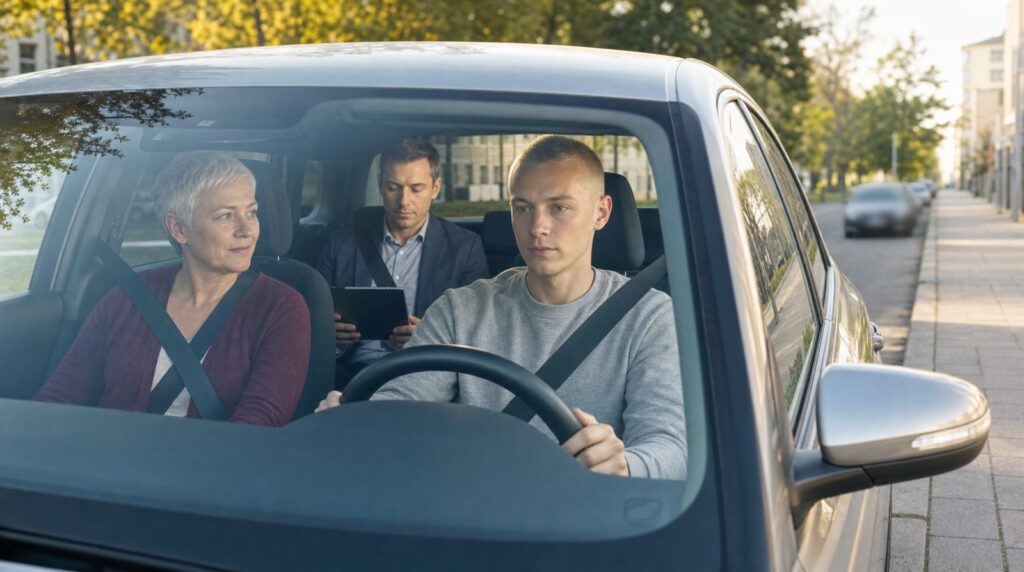
During the drive: What examiners pay special attention to
Examiners pay special attention to traffic monitoring and safe behavior in traffic. Checking the blind spot, mirror checks, and timely signaling are crucial. Compliance with speed limits and following distances is also closely observed.
Basic driving tasks such as hill starts, correct turning, parking and behaviour at stop signs are assessed with pinpoint accuracy. Learner drivers should ask questions if instructions are unclear and remain focused at all times.
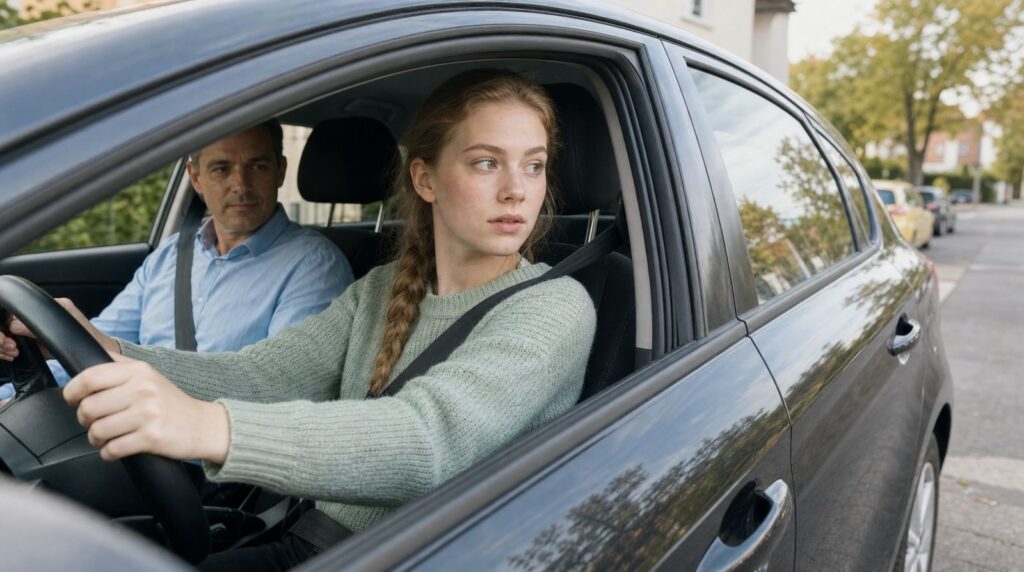
Keep calm: Don't panic when mistakes happen
Minor mistakes such as stalling the engine or drifting out of lane do not automatically result in a fail. The important thing is to regain your concentration and continue driving immediately after making a mistake.
Instant-fail errors, on the other hand, are severe violations: failure to yield, endangering other road users, running red lights, or repeated rule violations. Knowing these limits provides certainty and reduces test anxiety.
Mental preparation &
Tips for exam anxiety
Exam anxiety is normal. Simulations, mock tests with the driving instructor and targeted breathing exercises help to reduce nervousness. Positive thinking and belief in one's own preparation create the best conditions for a successful test.

What to do if it doesn't work?
Failing is not the end of the world. After a failure, there is a waiting period of about two weeks before the next test is possible. Additional driving lessons can clear up uncertainties. Learner drivers should analyse their experience, practise in a targeted way and approach the next test with confidence.
The cost of a retake exam varies depending on the test centre and any additional driving lessons. All prices and fees at a glance. Nevertheless, the rule is: stay calm and learn from your mistakes.
The most common mistakes in the practical test – and how to avoid them
From our daily practice we know: most cases of diarrhoea have two causes – insufficient traffic monitoring (“looking too little”) and a training that was not yet ready for examination. The latter is rarely the pupil's fault, but usually the result of training that was not thorough enough – which is why choosing a good driving school is so important.
First things first: As soon as the If the driving instructor has to intervene – whether by grabbing the steering wheel or pressing a pedal – you have failed immediately. Such an intervention typically happens when, for example, you change lanes without checking your blind spot and someone is driving right next to you. That is precisely why checking your blind spot is so crucial.
More severe errors, which immediately result in a failure:
- failing to stop completely at a stop sign
- Changing lanes or turning without a shoulder check – the classic mistake that often triggers the intervention
- Incorrect positioning when turning on a multi-lane road (ending up in the wrong lane)
- failing to give way or disregarding right of way rules
- Missed something important (pedestrians, cyclists, signs)
- Joining the motorway too slowly or driving too slowly in general
A shift in perspective that takes away the nervousness: The examiner doesn't want to fail you – they're just checking the driving instructor's work and will issue the driving licence as soon as you're competent enough to continue learning safely on your own. So you don't have to drive perfectly. Just show what you've learned.
Tips for exam day
Turn up on time
Avoid waiting times, stay calm.
Keep calm
Ignore tailgaters and external distractions.
Communication
Questions in case of ambiguities, do not be afraid to ask.
Technical check
Check seat, mirrors, handbrake.
to have the basic driving manoeuvres ready
Pulling away, turning, blind spot check, parking.
Revision checklist
1. Identity card/Passport
2. Training certificate
3. Vision test certificate
4. First-aid course
5. Biometric passport photo
6. Comfortable clothing & flat shoes
7. Driving lessons completed with good preparation
8. Exam simulations carried out
9. Mental relaxation & sleep
10. Positive mindset and trust in the preparation
Current figures: How many pass the practical test?
A look at the test statistics helps to counter unfounded pressure: according to the TÜV Association, the latest figure (2025) was around 37 percent of practical car driving tests failed – more than one in three drives. Anyone who fails is therefore anything but an isolated case, and anyone who passes has achieved something real. One further guide from our blog fits this topic exactly: Failed – what now? (Deadlines, costs and the plan for attempt two, in case it does happen).
Frequently asked questions about the practical driving test
How long does the practical test take?
For the car driving licence (category B) 55 minutes, for the motorcycle categories 70 minutes (upgrade test: 60 minutes).
Do I have to drive perfectly to pass?
No. You only need to drive safely and well enough to continue learning independently afterwards. Minor mistakes are allowed – only serious mistakes lead to a fail.
What leads to an immediate fail?
Every intervention by the driving instructor (taking the steering wheel or operating a pedal); furthermore, e.g., not stopping at a stop sign, changing lanes without checking the blind spot, cutting someone up or overlooking something important.
How long do I have to wait after failing?
Usually about two weeks until the next appointment – the second attempt is often easier because you already know the procedure.
What do the examiners focus on the most?
On traffic observation, consistent blind spot checks, an appropriate speed and overall safe, confident driving.
What helps against exam nerves?
Remember: the examiner wants you to pass. Just show what you've learned – and it's best to keep the appointment to yourself so you don't build up any pressure.
Read more
Conclusion: Pass practical test
The practical driving test can be passed on the first attempt with the right preparation, calmness and the tips presented here. Learner drivers should focus on the basic driving manoeuvres, brush off minor mistakes, reduce test anxiety through simulations and approach the driving test with self-confidence.
With these practical tips and the support of an experienced Driving school in Frankfurt you have the best conditions to be successful on test day and hold your driving licence in your hands.
Also in other matters – like Tips for passing the theory driving test, Questions regarding the disqualification from driving, Frankfurt Driving School Intensive Course or much more – Fahrschule FAHRPLAN is your point of contact!
Contact us here, to register for the driving school!
The overview shows what happens before and after the practical test. This is how you get your driving licence.