
Guide · Test passed
Can you drive alone straight away, what applies during the probationary period and what should you watch out for with your first car and insurance?
The examiner nods, says “passed” – and after the initial cheers comes a surprisingly long list of open questions: Can I drive off immediately? Where is the real driving licence? How much is the insurance going to cost me? And why does driving alone suddenly feel so daunting? Here is the complete roadmap for the period immediately after passing your test.
- Can I drive right away? Yes – this is how it works
- Probation starts now – the short version
- The first solo drives: the step-by-step plan
- First car and insurance: the new driver basics
- The most common mistakes of the first few months – and how to avoid them
- Good to know for later
- Frequently asked questions after passing the exam
- Conclusion: The driving licence is the beginning, not the end
Can I drive right away? Yes – this is how it works
Upon passing, the examiner will hand you usually the photocard driving licence directly off – then you are literally allowed to drive home from the test centre. If the licence has not yet been issued, depending on the region, there is a provisional test certificate or a provisional proof of driving authorisation: You are also allowed to drive immediately with that – however only in Germany, only together with your identity card, and for a limited period (three months is usual), until the photocard driving licence arrives. When BF17 does the special rule apply: test certificate plus registered accompanying person – all about it in the guide Accompanying driving.

Probation starts now – the short version
Your is granted upon issuance two-year probation period. The two rules that you really need to internalise: Zero alcohol (the alcohol ban applies during the probationary period and generally under 21 – and now expressly includes cannabis) and the A/B violation systemA serious violation (e.g., running a red light, using a mobile phone while driving, significantly speeding) means a remedial driving course and extension of the probationary period to four years. No panic details at this point – the complete, sober explanation including examples is in the guide. Probationary period for a driving licence.
The first solo drives: the step-by-step plan
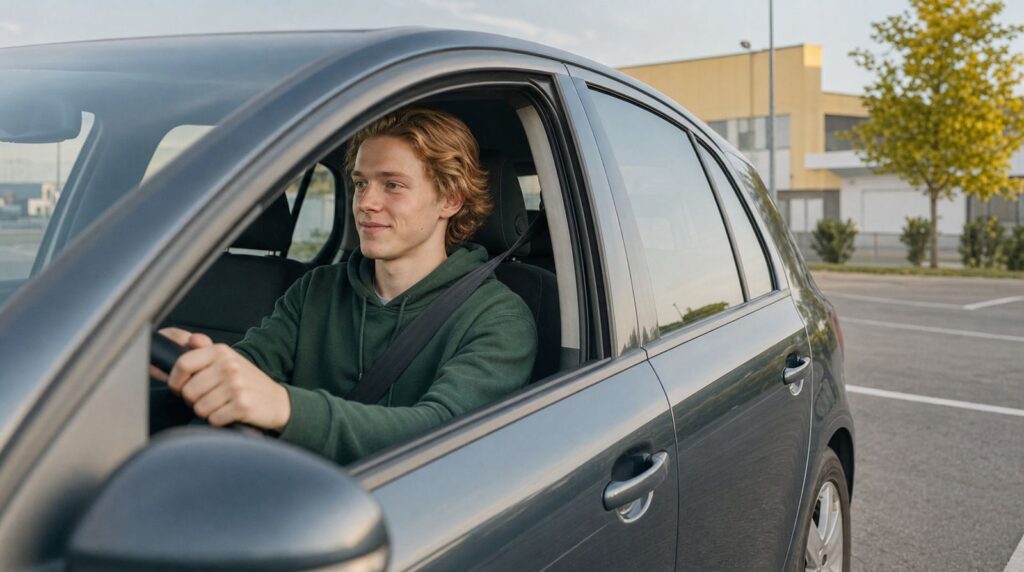
Between “driving test passed” and “driving relaxed on your own” lies a gap that hardly anyone talks about: the test confirms your ability – the feeling of safety only comes through driving. Here is how you can close the gap systematically:
- Trips 1–5: known short journeys during quiet times – supermarket, Sunday morning commute. The goal is not distance, but the feeling “I can do this alone”.
- Then increase selectively: Rush hour, multi-storey car park, rain, darkness, first motorway drive – consciously “tick off” each environment once, while the training is still fresh.
- Do not put it off: The first four weeks are crucial. Anyone who drives regularly straight after passing their test cements the routines learned in driving lessons; anyone who takes a break for months practically has to start all over again. If the initial barrier feels high: The guide Anxiety in driving lessons has its own section on driving alone – including permission to treat oneself to refresher lessons.
- An advanced driver training course (e.g. with road safety organisations or motoring clubs) is the best investment of the first year: experiencing emergency braking, swerving and aquaplaning once under safe conditions – no driving lesson in real traffic can achieve that.
First car and insurance: the new driver basics
Without making promises about figures (tariffs change constantly), but with the mechanisms you should know about:
- The no-claims bonus is the major cost lever: new drivers start right at the bottom and pay correspondingly high premiums – every accident-free year improves the rating.
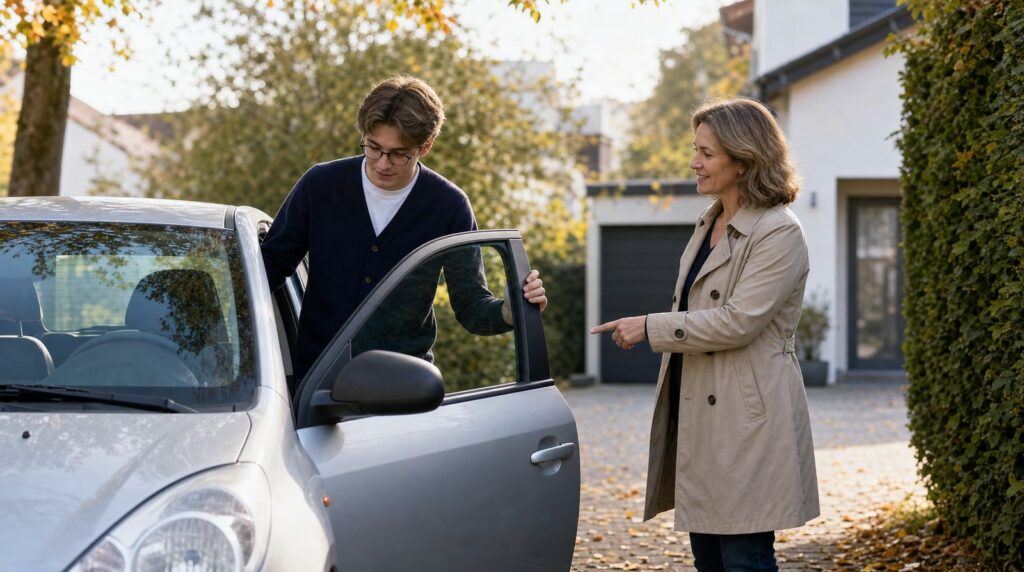
- Standard legal ways to save money: one's own car as Second car insured via parents to turn out to be Add driver to the family car leave (this also accrues discount benefits with some insurers) or Telematics insurance policies, which use an app to assess driving style and reward defensive driving.
- When buying a car is it worth looking at the Insurance group of the model (smaller = cheaper insurance) – the classic “weak small car instead of a used sports car” is not bourgeois wisdom, but simple premium mathematics. And think about the gearbox question: whoever B197 who does so consequently drives an automatic or electric car for personal use too.
The most common mistakes of the first few months – and how to avoid them
- Tailgating: Keeping your distance is the first virtue that gets lost in everyday driving – and with it the most frequent cause of accidents among young drivers. The rule of thumb “half the speedometer reading” applies just as much after the test as before it.
- Distraction: Mobile phone, sat-nav tapping, loud friends, eating at the wheel – unthinkable at driving school, but creeping into everyday life as the norm. The phone belongs physically out of reach; during the probationary period, it costs a penalty point plus the risk of an improvement seminar anyway.
- The exuberance of the third month: The statistically trickiest window doesn't come right after the test, but when the initial uncertainty wears off and overconfidence takes over. Anyone who catches themselves driving more “sportingly” than they did during their training should read that as a warning sign—not as progress.
- Underestimating tiredness and night driving: The drive home from the party is the most dangerous routine drive for novice drivers – not because of alcohol (0.0 applies anyway), but because of fatigue and darkness. When in doubt: leave the car behind, get a lift, being picked up at night is no drama for parents, an accident is.
- No longer wanting to learn: The exam is the start of the learning curve, not the end. Anyone who consciously regards the first few months as a continuation of their training (see the step-by-step plan above) will, after a year, be riding at a level that no exam in the world can certify.
Good to know for later
- Your photocard driving licence is valid for 15 years – that only concerns the document (like with the identity card), not your driving licence. What you need to do when renewing is in the guide Driving licence renewal.
- The points system accompanies you from now on: Depending on the severity, offences result in 1 to 3 points in Flensburg, and at 8 points the driving licence is revoked. For new drivers, however, the probationary period system is the more relevant benchmark – it takes effect earlier and harder.
- Trailers, motorbikes & co: With a category B licence, extensions are available to you – from Trailer driving licence B96/BE up to the 125cc or motorcycle class (our motorcycle sister site advises on this with its own Area of knowledge).
Frequently asked questions after passing the exam
When will my photo card driving licence arrive if I didn't receive it straight away?
That depends on the production and licensing authority situation – a few weeks is usual. Until then, you drive with the temporary proof (domestic only, carry ID). For driving abroad right after the test, it's better to wait until the card arrives.
Am I allowed to drive on the motorway or abroad immediately after the test?
Motorways: yes, straight away – you learnt this during your special training drives. Abroad: only once you have your full driving licence; the provisional licence and the BF17 certificate are generally valid only in Germany (BF17 exception: Austria).
As a new driver, am I allowed to carry passengers?
Yes, without restriction – Germany has no passenger limits for novice drivers. To be honest though: a car full of friends is the biggest distraction during the first few months. You will have the most relaxing start driving alone or with a calm front-seat passenger.
Should I continue taking driving lessons, even though I've passed?
If it gives you peace of mind: absolutely – refresher lessons after the test are a standard service and nothing to be ashamed of. More useful than “more of the same” is often an advanced driver training course combined with targeted lessons for whatever you find intimidating (multi-storey car parks, motorways, night driving).
Read more
Conclusion: The driving licence is the beginning, not the end
After the test, the real driver training begins – the one through experience. Drive early, drive regularly, consciously tick off the major environments and stick to the two probationary period basic rules. Then that fresh driving licence will have become second nature faster than you think today – and that is precisely what all the effort was for.
The page provides a look back at the entire journey there This is how you get your driving licence.