
Straight to the point: Everything you need to know about our B197 training course – the process, test drive, costs →
Guide · B197
What is B197, how does the training work and who is best suited to manual, B197 or automatic only?
Since April 2021, there has been a third option for the car driving licence between “classic manual” and “automatic only”: the B197. There’s hardly any other decision that preoccupies learner drivers more these days – and hardly any other that’s made so often on the basis of half-baked knowledge. Here’s an honest comparison: what B197 really is, where its limitations lie, and which route is right for whom.
- What is the B197 driving licence?
- B197, B78 or a traditional manual: a comparison of the three routes
- Here’s how the B197 training programme works in practice
- Is B197 valid abroad?
- The honest assessment: does B197 make you a manual driver?
- The advantages of B197
- The disadvantages and limitations
- Learning to drive an automatic: What is really different in training
- Subsequent switch: From the automatic licence (78) to the full category B
- Which path is the right one for whom?
- Myth-busting: What people say about B197 – and what’s true
- Frequently asked questions about B197
- Conclusion: The B197 is the right choice for most people
What is the B197 driving licence?
B197 is no independent driving licence and no “light version” Class B, but a special training and testing variant (§ 17a FeV, § 5a Fahrschüler-Ausbildungsordnung): You complete the entire training and the practical test in an automatic vehicle – and demonstrates the ability to drive a manual beforehand at the driving school. Two things are required for this:
- At least 10 driving lessons of 45 minutes each in a manual car – real training hours with clutch and gear change.
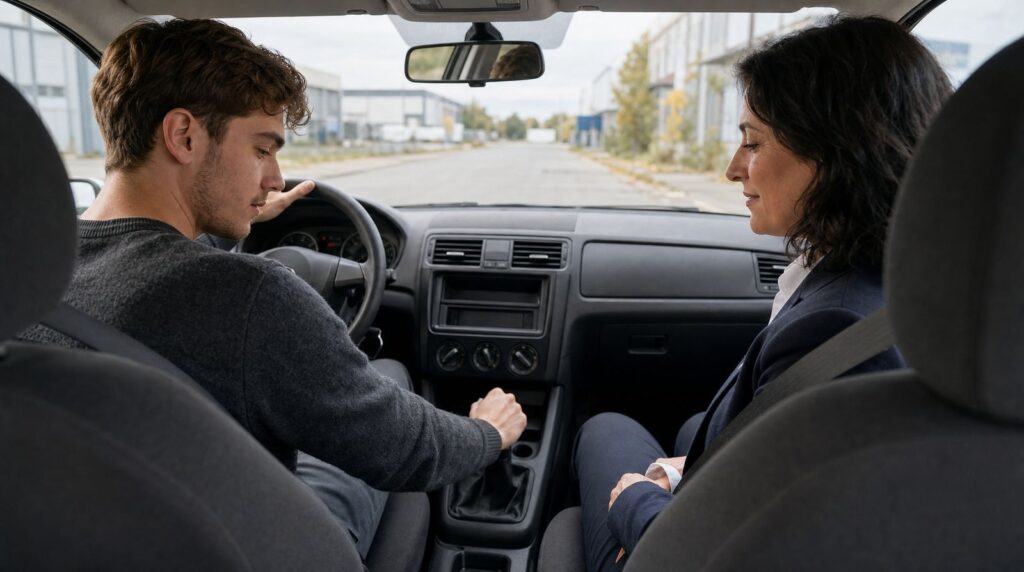
- A test drive lasting at least 15 minutes inside and outside built-up areas – important: This drive takes place at your driving instructor's instead, not with the examiner. It's not a second test, but a confirmation from your driving school.
Afterwards, the driving school will issue a Certificate of switching competence out, which you must present to the driving licence office within a year. The driving licence will then state the Code 197 – and you may Manual and automatic vehicles equally drive.
B197, B78 or a traditional manual: a comparison of the three routes
| Manual | B197 | Automatic only (B78) | |
|---|---|---|---|
| Training | entirely on flatbed lorries | mostly automatic + at least 10 shift hours | fully automatic |
| Exam | on a manual car | on automatic | on automatic |
| Driving a manual car? | Yes | Yes | No (Code number 78) |
| driving licence endorsement | none | Code 197 | Code 78 (restriction) |
| Test stress with clutch | Yes | No | No |
The crucial point: With B197, you get the full Class B – legally there is no difference to someone who passed their test in a manual car. Only the pure automatic variant (driving licence code 78) is actually restricted.
Here’s how the B197 training programme works in practice
The course structure is not as different from the traditional training programme as many people think – B197 only changes the practical component:
- 1. Registration and driving licence application run exactly as always – you don't have to commit yourself yet in the application, the direction is set at the driving school.
- 2. Theory remains identical: 12 double lessons of core material plus 2 double lessons of additional material, the same theory test with the same questions. There is no “automatic theory”.
- 3. Driving lessons predominantly in an automatic: Basic driving exercises, city driving, practical lessons – all in an automatic vehicle, leaving you with a clear head for the traffic.
- 4. The 10 switching hours: Usually towards the end of initial training, once you have already mastered driving itself – then the shifting technique is picked up much quicker. Moving off, shifting up and down, starting on a hill and manoeuvring with the clutch are practised.
- 5. The 15-minute test drive inside and outside built-up areas – with your driving instructor, without an examiner, without a waiting period. If it's not working yet, you simply carry on practising.
- 6. Certificate: The driving school confirms your manual shifting competence on the official form.
- 7. Special training drives and practical test in an automatic vehicle – completely normal, just without the clutch.
- 8. Certificate for the authorities: to be submitted within a year of completing training – then code 197 will go on the driving licence instead of 78.
Is B197 valid abroad?
The short answer: Yes, practically unproblematic. The key number 197 is a national German code – but what is decisive is what not your driving licence states: automatic restriction 78. Abroad, therefore, your driving licence is valid as a completely normal Category B driving licence without restriction. This means you can also hire a car with manual transmission on holiday – whether that is a good idea after ten manual lessons and extended automatic practice is another question (more on that in a moment).
The honest assessment: does B197 make you a manual driver?
Here advertising is separated from truth: Ten hours of gear-changing practice do not make you an experienced manual driver. They’re enough to enable you to understand and use the clutch, pulling away and changing gear safely – but it’s only through regular driving that you’ll develop the necessary routine. Anyone who takes the B197 test and then drives only automatic cars for years will initially feel uncomfortable in a manual car. It’s no big deal and perfectly legal – but you should be aware of this beforehand.
The good news for anyone who realises after the test that they want more gear-changing practice: you are allowed private manual driving lessons at any time do it (the driving licence allows it, after all) and you can without any new test Refresher lessons at the driving school take. No-one needs to feel ashamed for that – that is precisely what this option is there for.
The advantages of B197
- Learn more easily: Without a clutch and gear changes, more mental capacity remains free in the first few hours for the essentials – observing traffic, road positioning and keeping in lane. As a result, many learner drivers need fewer driving lessons overall.
- More relaxed examination: Stalling at the traffic lights, a botched hill start – those classic nervousness-induced mistakes are eliminated with an automatic vehicle.
- Future-proof: Electric cars and an increasing number of combustion-engine vehicles drive automatically. Anyone wanting to drive electric anyway simply no longer needs a gear-shifting routine in everyday life.
- Full authorisation: Unlike with a standard automatic-only licence, you remain permitted to drive manual cars – from removal vans to older second-hand vehicles.
The disadvantages and limitations
- Limited switching routine: The ten mandatory hours are a foundation, not a roof. Anyone who is going to drive a manual car every day (family car, company car) is better off with the traditional training.
- Slightly higher hourly rates possible: Some driving schools charge a small surcharge for automatic driving lessons – but on balance, this often evens itself out because B197 learners tend to need fewer lessons. You can find the specific prices clearly listed on our Pricing page.
- Applies to category B only: The manual transmission competence certificate relates to the car driving licence. Anyone who wants to acquire lorry or bus categories later and takes their test in an automatic vehicle will receive a separate automatic regulation for those categories again – though for the vast majority of learner drivers this is not an issue.
Learning to drive an automatic: What is really different in training
Anyone who has never sat in an automatic car often imagines the difference to be smaller than it actually feels – and in a positive way:
- Two pedals instead of three: Accelerator and brake, both with the right foot – the left foot takes a rest. Stalling, the number one bogeyman of all learner drivers, simply does not exist.
- Hill start: without clutch play and rollback panic – the car handles it, often supported by an automatic hill start assist.
- More capacity for traffic: What manual-driving pupils pour into concentration on the clutch and gear selection flows into gaze direction, mirrors and anticipatory driving from the very first lesson with automatic driving – precisely the things that are assessed in the test.
- Electric car included: Electric cars are always automatic vehicles. Anyone who learns in a modern automatic or electric vehicle is learning on the type of propulsion that has long dominated the new car market.
Against this background, the manual transition lessons feel like a compact crash course: you learn the principle of clutch, gear and revs intensively in ten hours, rather than dragging it out over the entire training. Many learner drivers find this exact sequence—first learn to drive, then learn to gear change—to be the more logical one.
Subsequent switch: From the automatic licence (78) to the full category B
Do you already have an automatic-only driving licence with code 78? Since 2021 there are two ways to get rid of the restriction: one practical test in a manual car (shortened to 45 minutes) – or, only for category B, the B197 route via the driving school: at least 10 hours of driving plus a 15-minute test drive, a certificate for the authorities, and that’s it. No exam stress, no TÜV appointment. For many drivers of automatic cars, this is the most relaxed way to get a full driving licence.
Which path is the right one for whom?
- B197 is right for you if: you want a more relaxed learning experience and test, your everyday car (now or later) is an automatic or electric vehicle, and you only need the manual car occasionally.
- A classic outfit suits you if: Since you certainly know that you will regularly drive a manual car – for instance because the family car has a gear stick or your future job involves driving vans.
- Only automatic (78) is right for you if: you’re 100 per cent sure you never want to drive a manual car – and even then, the B197 is usually the wiser choice, because the extra effort involved is minimal and the freedom it offers is considerable.
Myth-busting: What people say about B197 – and what’s true
- “B197 is an automatic driving licence.” Incorrect. B197 covers the full Class B licence – both manual and automatic vehicles are permitted. The licence for automatic vehicles only has the code 78, not 197.
- “If you drive a B197, you’re considered a worse driver.” The code number simply indicates the training pathway. Insurance companies, car hire firms and employers treat B197 in exactly the same way as any other Class B licence.
- “The test drive is a second test.” No – it takes place with the driving instructor, without an examiner, without a fee, without the risk of failing and having to wait.
- “B197 is not valid abroad.” Yes. The crucial thing is that NO automatic restriction (78) is entered – your driving licence is valid everywhere as a normal category B licence.
- “You must not tow any trailers with a B197.” However, the same trailer regulations apply as for any Class B vehicle, and the B96 and BE extensions are also available to you.
Frequently asked questions about B197
If you see B197 on your driving licence – does that mean it’s a “worse” driving licence?
The code 197 does appear on your driving licence, yes. But it is not a restriction; it simply documents your training history. Legally, you have exactly the same driving licence as any other Class B licence holder – it makes no difference to the police, car hire companies or insurance firms.
Do I have to “pass” the 15-minute test drive?
The test drive isn’t an exam where you risk failing the TÜV – your driving instructor simply uses it to confirm that you can change gears safely. If you’re not quite ready yet, you can simply take more gear-changing lessons until you’re ready. There’s no examiner, no report and no waiting period.
Is the B197 more expensive than a standard driving licence?
Generally not worth mentioning. The 10 manual transmission hours are part of the normal training (instead of other practice hours), and what automatic lessons might cost extra, many save again through needing fewer hours overall. Decide based on your driving profile, not a matter of a few pounds difference.
I have B197 – and I do not really dare get into a manual car. What should I do?
Completely normal and easily solvable: a few private practice drives in a quiet environment or two or three refresher lessons at the driving school – completely without a new test. Manual transmission skills do not expire; it's simply about building up routine.
Can I switch to the B197 course whilst I’m still in the middle of my training?
Yes, it’s usually no problem – just speak to your driving school. Any manual gear-change lessons you’ve already completed count towards your manual gear-change proficiency certificate; conversely, you can also switch back from B197 to the traditional manual gear-change test if you find that manual gear-changing suits you.
Can I save myself any of the 10 switching hours?
No – the 10 driving lessons of 45 minutes each in the manual car are the legal minimum for the manual competence certificate. Anyone who learns to shift gears safely more quickly simply uses the remaining hours for more demanding exercises such as hill starts or manoeuvring.
Read more
Conclusion: The B197 is the right choice for most people
The B197 combines the best of both worlds: a more relaxed approach to learning and taking your test in an automatic car, a full driving licence valid for both manual and automatic vehicles, and no restrictions when driving abroad. Only those who are certain that a manual car will be their everyday vehicle should opt for traditional training. If you’re unsure which route is right for you: On our B197 page you'll find all the details about training with us – and during the registration chat we'll advise you honestly, with no extra-cost drama.
Once you have decided, it shows you This is how you get your driving licence one further step.