
Guide · Trailer licence
What combination of vehicles are you allowed to tow with a category B licence, and when do you need B96 or BE?
The caravan has been chosen, the horse trailer is in the yard – and suddenly a question arises that never seemed to be an issue before: Am I even allowed to tow the combination with my standard driving licence? The answer lies in a simple calculation – and in two licence extensions that involve very different levels of effort: B96 and BE. Here is the complete guide to help you decide.
- Step 1: What are you already allowed to tow with a standard Category B licence?
- The gross vehicle weight rating calculation in two minutes
- B96: the day course without an exam
- the “real” trailer licence
- The direct comparison
- Three typical cases, calculated
- After qualification: What remains important in carriage driving
- Frequently asked questions about B96 and BE
- Conclusion: calculate first, book afterwards
Step 1: What are you already allowed to tow with a standard Category B licence?
More than many think. With a category B licence, you are allowed to:
- Trailers up to 750 kg maximum authorised mass (MAM) – always, no matter how heavy your car is.
- Trailers over 750 kg gross vehicle weight, provided that the maximum authorised mass of the Combination Car + trailer does not exceed 3,500 kg.
For small trailers, DIY store trailers and light caravans towed by compact cars, a Class B licence is therefore often perfectly adequate. Things get a bit tricky with heavy towing vehicles (SUVs, vans) plus full-size caravans or horse trailers – that’s when the B96 or BE licences come into play.
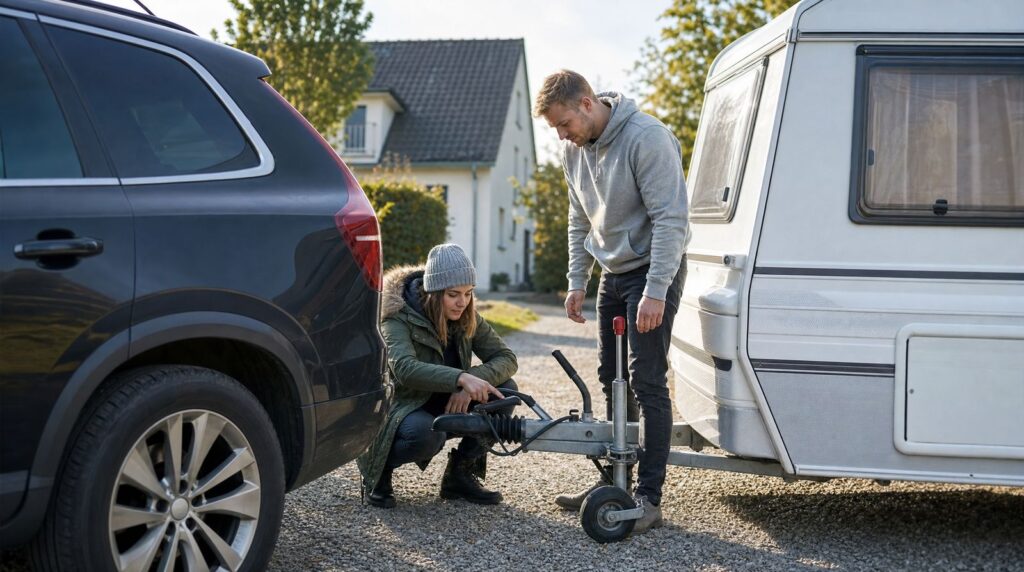
The gross vehicle weight rating calculation in two minutes
What is crucial is never the actual weight, but always the maximum authorised mass from the vehicle documents (registration certificate part I, field F.2): GVW towing vehicle + GVW trailer = GVW of the combination. An empty horse trailer with a gross vehicle weight rating of 2,000 kg counts as 2,000 kg – even without a horse. Check two additional things: the Towing capacity of your car (also the vehicle registration certificate – it limits what the car is allowed to tow, independently of the driving licence) and the nose weight. Driving licence, towing capacity and loading are three separate limits – all three must be complied with.
B96: the day course without an exam
B96 is not a driving licence in its own right, but rather a driving licence code, which extends your category B: combinations with a trailer over 750 kg and a Total mass over 3,500 to 4,250 kg. The way there is deliberately kept simple:
- No test – neither theory nor practice.
- A Driver training of at least 7 hours in one day: at least 2.5 hours of theory, at least 3.5 hours of practical exercises (shunting, coupling, driving exercises) and at least 1 hour of driving in real traffic per participant.
- At the end there is a Certificate of attendance, with which the driving licence authority enters code number 96.
Cost estimate as a magnitude: a low to mid three-figure amount – significantly cheaper and faster than BE. And because code 96 is EU-wide, it is also valid in other European countries.
the “real” trailer licence
If even the B96 isn’t enough – for example, when towing a heavy horse trailer behind an SUV – the solution is Class BEClass B towing vehicle plus trailer up to 3,500 kg gross vehicle weight rating (above which C1E begins). The good news for anyone who dreads exams:
- No theory test and no compulsory theory lessons – BE is a purely practical training course.
- Practical training included 5 special training drives (3 rural, 1 motorway, 1 night drive) plus practice lessons as required – key focus areas are manoeuvring with a trailer, hitching up with a safety check, and the different driving feel (length, corners, braking distance).
- A 55-minute practical test (at least 30 minutes driving time), including basic driving tasks with a trailer as well as hitching and unhitching.
Time required: depending on prior experience, usually a few weeks. Costs are roughly in the mid to high hundreds – you can find our specific BE prices on the Class BE page.
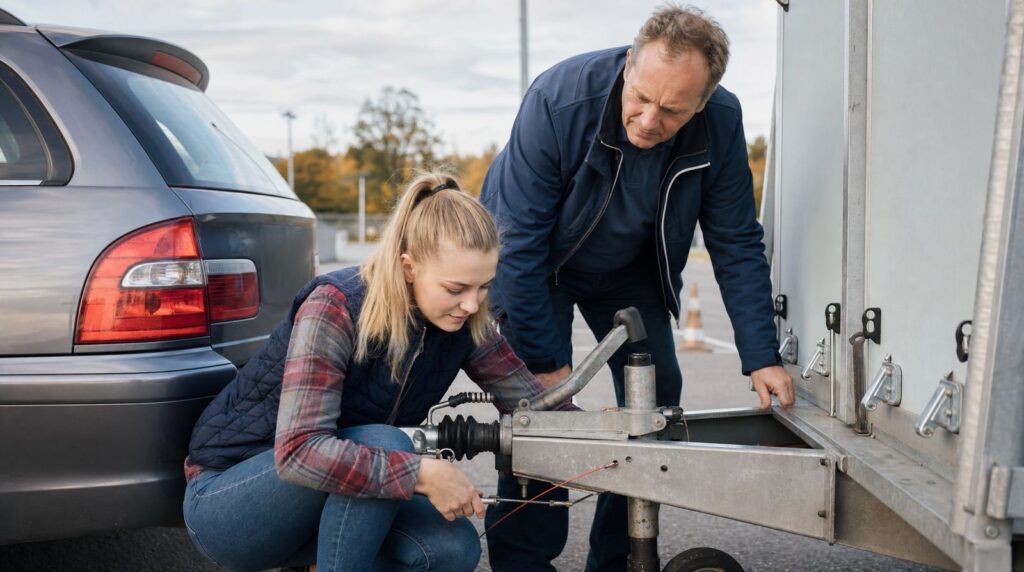
The direct comparison
| Class B | B96 | Be | |
|---|---|---|---|
| Combination (GVW) | up to 3,500 kg | over 3,500 to 4,250 kg | Trailer up to 3,500 kg gross vehicle weight |
| Effort | – | 1 training day (min. 7 hours) | Practical training + examination |
| Exam | – | None | Practical exam (55 mins) |
| A typical combination | small trailer, lightweight caravan + compact car | medium-sized caravan + SUV | Horse trailer, large caravan, car trailer |
| Cost (approximate) | – | a low to medium three-figure sum | mid- to high three-figure sum |
Three typical cases, calculated
- Compact SUV (gross vehicle weight 2,000 kg) + small caravan (gross vehicle weight 1,200 kg) = 3,200 kg: under 3,500 kg – Class B is sufficient, no extension required.
- SUV (GVW 2,400 kg) + family caravan (GVW 1,700 kg) = 4,100 kg: over 3,500, under 4,250 kg – B96 is sufficient: a day’s training, no exam.
- SUV (GVW 2,500 kg) + horse trailer (GVW 2,700 kg) = 5,200 kg: over 4,250 kg – there’s no getting round it Be That’s it (the trailer’s maximum authorised mass remains below 3,500 kg, so a BE licence is sufficient).
After qualification: What remains important in carriage driving
A driving licence or registration are your ticket in – but in everyday life, three other factors determine whether you can enjoy a relaxed ride with a trailer:
- Speed limit: When towing a trailer, the following generally applies on country roads and motorways Speed limit 80 – You may only drive at 100 km/h on motorways and expressways if you have the “100 plaque” (which certifies that the trailer is authorised for 100 km/h, subject to conditions such as tyre age and drawbar load).
- Load and drawbar load: Place heavy items at the bottom and across the axle, secure the load, and make the most of the drawbar load rather than minimising it – a correctly loaded trailer runs smoothly, whilst an incorrectly loaded one starts to sway. It is precisely this topic that takes up a great deal of time in the B96 training course and the BE training programme, and for good reason.
- Establish a routine: If you only tow a trailer twice a year, you should treat yourself to half an hour of manoeuvring practice in an empty car park before setting off on holiday – reversing with a trailer is something that takes practice, for everyone.
Frequently asked questions about B96 and BE
Is the B96 valid abroad?
Yes – the code 96 is standardised across the EU and is recognised in all EU countries. (Not to be confused with the purely national motorcycle extension B196 – which applies only in Germany.)
Can I take BE straight away, without doing B96 first?
Yes. The B96 is not a preliminary stage, but an alternative for the range up to 4,250 kg. Anyone who expects to tow heavier loads can skip the intermediate stage and go straight for the BE licence.
Do I need this for BE theory lessons or a theory test?
No – both of these do not apply at all with BE. There is only the practical training with the 5 special training drives and the practical test.
B96, B196, B197 – what’s the difference?
Three completely different things with numbers so similar they could easily be confused: B96 = Trailer extension (this article), B196 = 125cc motorcycle extension (explained in Topics covered on our motorbike website), B197 = Automatic training with manual competence (our guide: B197 or manual?).
Read more
Conclusion: calculate first, book afterwards
Ultimately, the decision comes down to simple maths: for combinations up to 3,500 kg, a Class B licence is sufficient. Up to 4,250 kg, you’ll need a B96 training day without an exam. Above that (or for a heavy single trailer), you’ll need a BE licence with a practical test, but no theory test at all. Work out the figures using the maximum authorised combination weight (zGM) values from your documents, check your car’s towing capacity – and if you’d prefer to go through the results together: on our passenger side outlines how trailer training works with us.
For the complete procedure for the Category B basic training, click here: This is how you get your driving licence.