
Guide · Traffic signs
Which sign means what, who has priority and when do you zip merge?
In Germany, traffic signs regulate what applies at a particular place: they warn, require, prohibit or give information. Here you will find the most important signs with picture, sign number and meaning, plus the mistakes that come up most often in the theory test and in everyday driving. All information is based on the German Road Traffic Regulations (StVO) and their annexes.
In short
- There are three types of traffic signs: warning signs, regulatory signs and information signs. Supplementary plates and road markings are traffic signs too.
- Warning signs are usually triangles with a red border. Outside built-up areas they are generally placed 150 to 250 metres before the hazard.
- Regulatory signs impose requirements and prohibitions. They apply where the sign stands or from that point onwards.
- Information signs give guidance, but can also contain requirements or prohibitions, for example the priority road.
- Traffic signs take precedence over the general rules. Traffic lights take precedence over priority signs, and police officers take precedence over everything.
- If nothing is regulated at a crossroads, priority to the right applies.
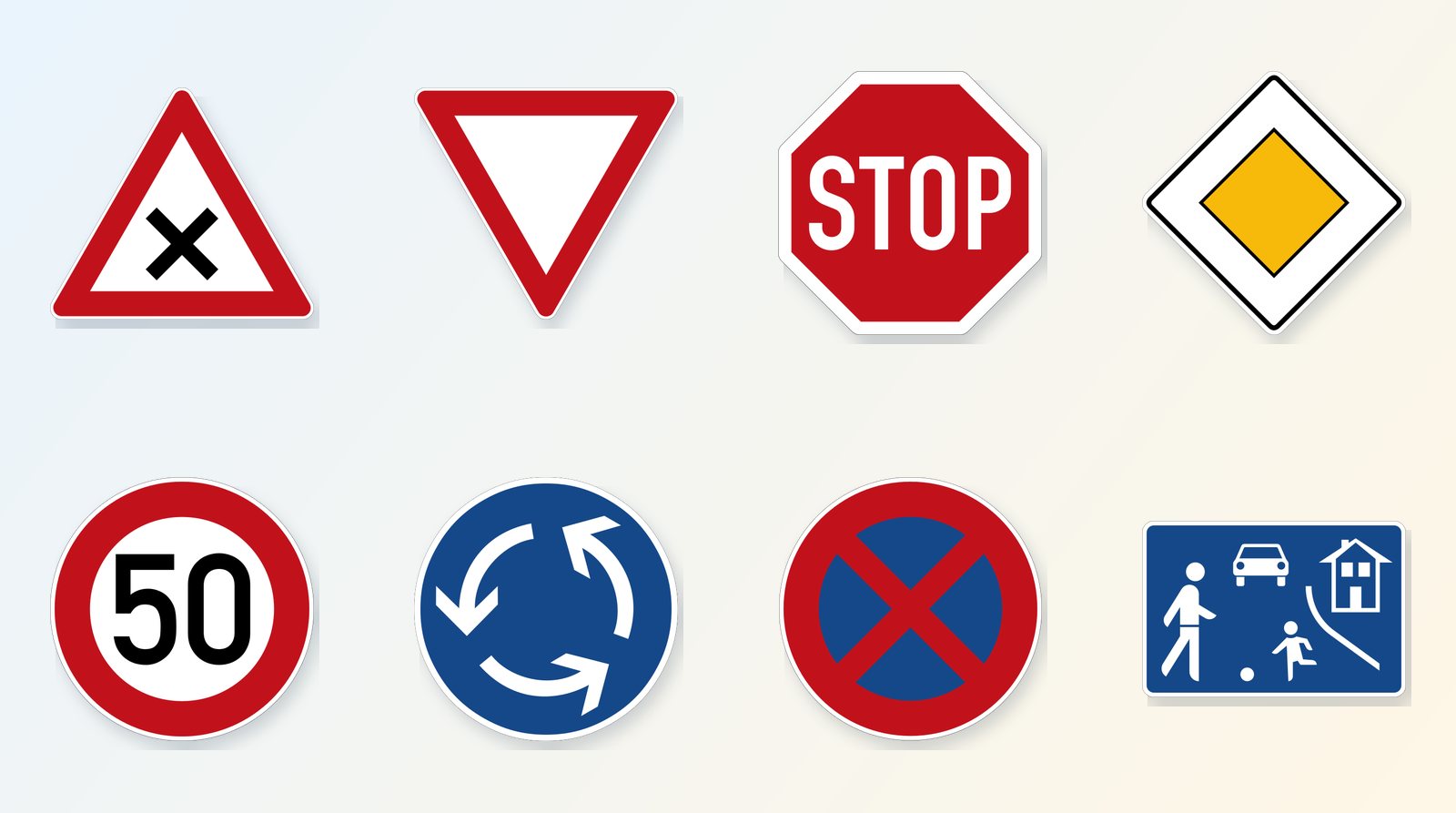
The types of signs at a glance
The shape and colour usually tell you which group a sign belongs to and how binding it is.
| Type | Typical appearance | What they do | Legal basis |
|---|---|---|---|
| Warning signs | triangle with a red border, point at the top | warn of a hazard; you drive more attentively and usually more slowly | § 40 and Annex 1 StVO |
| Regulatory signs | mostly round: prohibitions with a red border, requirements in blue; plus "Stop", "Give way" and the St Andrew's cross | impose requirements and prohibitions | § 41 and Annex 2 StVO |
| Information signs | mostly rectangular, often blue or yellow | give guidance, sometimes with requirements or prohibitions | § 42 and Annex 3 StVO |
| Supplementary plates | white with a black border, usually below the main sign | restrict, extend or explain the sign above | § 39(3) StVO |
| Traffic control devices | beacons, traffic cones, barriers, delineator posts | close off areas, guide traffic past them or mark the edge of the road | § 43 and Annex 4 StVO |
Yellow lines at roadworks take precedence over white ones. Yellow markings are only temporary and cancel the white ones (§ 39(5) StVO).
The most important traffic signs in one table
| Sign | Name | What you have to do |
|---|---|---|
| 205 | Give way | wait if traffic with priority is coming |
| 206 | Stop. Give way. | always stop, then give way |
| 301 | Priority | priority only at the next crossroads |
| 306 | Priority road | priority until further notice |
| 102 | Crossroads or junction | priority to the right applies ahead |
| 208 | Priority for oncoming traffic | wait at the narrow section |
| 308 | Priority over oncoming traffic | go first at the narrow section |
| 215 | Roundabout | drive anticlockwise |
| 220 | One-way street | drive only in the direction of the arrow |
| 267 | No entry | do not drive in |
| 250 | No vehicles of any kind | no vehicles |
| 274 | Maximum speed limit | no faster than shown |
| 276 | No overtaking for motor vehicles of any kind | do not overtake multi-track motor vehicles |
| 282 | End of all route-related speed limits and overtaking bans | general speed limits apply again |
| 283 | No stopping | do not stop |
| 286 | Restricted stopping | stop for a maximum of three minutes |
| 310 | Town sign | built-up area, so 50 km/h |
| 325.1 | Start of a traffic-calmed area | walking pace |
Warning signs: danger ahead
Warning signs call for extra attention, above all for driving more slowly (§ 40 StVO). Outside built-up areas they are generally placed 150 to 250 metres before the hazard, in built-up areas shortly before it. If the distance is much shorter or the hazardous stretch is longer, this may be shown on a supplementary plate.
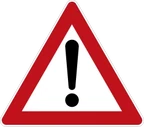
Hazard
Sign 101
Warns of a hazard in general. A supplementary plate below it can specify the hazard.
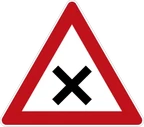
Crossroads or junction
Sign 102
Warns of a crossroads or junction with priority to the right.
This sign does not give you priority. It announces that priority to the right applies at the next crossroads.
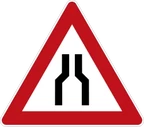
Road narrows
Sign 120
Warns that the road is getting narrower.
This sign does not decide who may go first at a narrow section. Where necessary, signs 208 and 308 do that.
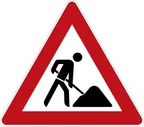
Roadworks
Sign 123
Warns of roadworks on or next to the road.
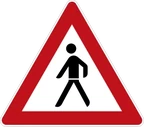
Pedestrians
Sign 133
Warns that pedestrians may cross the road.
This sign is not a zebra crossing. A pedestrian crossing is only indicated by sign 350 together with the zebra markings (sign 293).
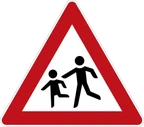
Children
Sign 136
Warns that children may run onto the road, for example near schools or playgrounds.
Near children you must drive more slowly and be ready to brake so that nobody is put at risk (§ 3(2a) StVO).
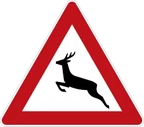
Wild animals
Sign 142
Warns that wild animals may cross the road.
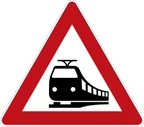
Level crossing
Sign 151
Warns of a level crossing. In front of it there are often countdown markers with three, two and one stripe.
The countdown markers stand about 240, 160 and 80 metres before the level crossing.
Regulatory signs: requirements and prohibitions
You must obey regulatory signs (§ 41 StVO). They stand where the rule applies or where it begins. If a sign stands some distance before that point, a supplementary plate gives the distance.
Priority and right of way
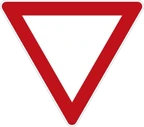
Give way
Sign 205
You must give way. The sign stands directly before the crossroads or junction.
Unlike at "Stop", you do not always have to stop. But you must show by driving at a moderate speed that you are going to wait (§ 8(2) StVO).
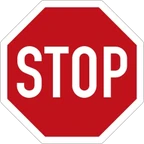
Stop. Give way.
Sign 206
You must stop and give way. If there is no stop line, you stop where you can see the other road.
Rolling through slowly is not enough. Stopping means: the vehicle is standing still.
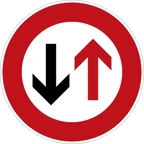
Priority for oncoming traffic
Sign 208
You must give priority to oncoming traffic, usually before a narrow section.
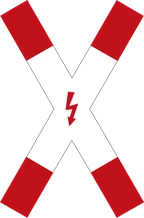
St Andrew's cross
Sign 201
Rail vehicles have priority. A lightning arrow in the middle indicates a live overhead line.
You must not park within 5 metres in front of or behind the St Andrew's cross in built-up areas, and within 50 metres outside built-up areas.
Direction of travel and special lanes
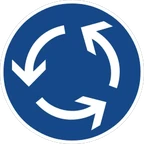
Roundabout
Sign 215
You drive anticlockwise around the roundabout and must not stop on the circular carriageway. Only large vehicles that cannot get through otherwise may drive over the central island.
Traffic on the roundabout only has priority if there is also a "Give way" sign. In that case you do not indicate when entering (§ 8(1a) StVO).

One-way street
Sign 220
You may only drive along the one-way street in the direction of the arrow.
A supplementary plate can allow cyclists to ride in the opposite direction. Then you must expect oncoming cyclists.
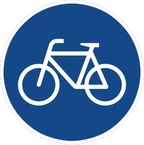
Cycle path
Sign 237
Cyclists must use the cycle path; other traffic must not use it.
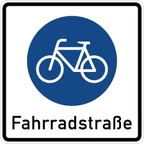
Start of a cycle street
Sign 244.1
Apart from bicycles and small electric vehicles such as e-scooters, vehicles may only enter if a supplementary plate allows it. The speed limit is 30 km/h, and cyclists may ride side by side.
Even if cars are allowed, cyclists must not be endangered or obstructed. If necessary, you must drive even more slowly.
Traffic bans
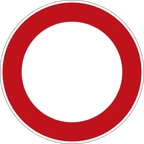
No vehicles of any kind
Sign 250
Vehicles must not be driven here. You may push motorcycles and bicycles.
The empty white circle is not information but a ban on all vehicles. Exceptions are handcarts, riders, people leading horses and livestock drovers. Supplementary plates can allow further exceptions.
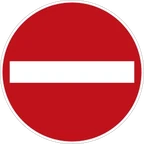
No entry
Sign 267
You must not enter the carriageway to which the sign applies. It often stands at the end of a one-way street.
Speed and overtaking
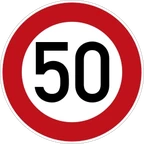
Maximum speed limit
Sign 274
You must not drive faster than shown.
If the sign allows a higher speed outside built-up areas, the specific limits for certain vehicles still apply, for example for cars with a trailer.
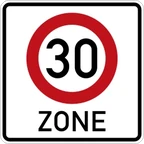
Start of a 30 km/h zone
Sign 274.1
You must not drive faster than 30 km/h anywhere in the zone.
The limit is not repeated after every crossroads. It applies until the sign for the end of the zone.
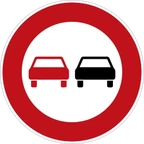
No overtaking for motor vehicles of any kind
Sign 276
You must not overtake multi-track motor vehicles or motorcycles with a sidecar.
You may overtake single-track vehicles such as motorcycles without a sidecar, mopeds and bicycles. Cyclists, however, only with a gap of at least 1.5 metres in built-up areas and 2 metres outside them (§ 5(4) StVO). A separate sign (277.1) can prohibit this as well.
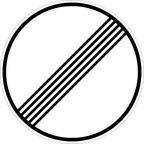
End of all route-related speed limits and overtaking bans
Sign 282
All speed limits and overtaking bans set earlier end here.
This does not mean there is no limit. The general speed limits apply again, so 50 km/h in built-up areas.
The end of a speed limit or overtaking ban is not always signposted separately. If a supplementary plate gives the length of the stretch, or if the ban is shown together with a warning sign, it ends without a separate sign as soon as the stretch is over or the hazard clearly no longer exists.
Stopping and parking
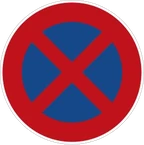
No stopping
Sign 283
Stopping on the carriageway is prohibited, even briefly.
The ban applies only on the side of the road where the sign stands and up to the next crossroads or junction, unless another sign says otherwise.
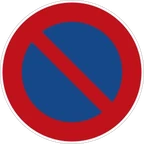
Restricted stopping
Sign 286
You may stop for a maximum of three minutes. Longer only to let people get in or out or to load or unload.
You must load and unload without delay.
Information signs: guidance, priority and places
Information signs give special guidance to help traffic flow (§ 42 StVO). Some also contain requirements or prohibitions that you must obey, for example the priority road or the traffic-calmed area.
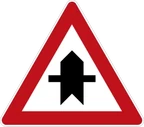
Priority
Sign 301
You have priority at the next crossroads or junction.
This sign applies only to the next crossroads. It looks like a warning sign, but it is an information sign.
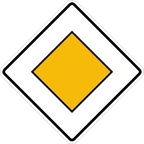
Priority road
Sign 306
You have priority until a "Give way" sign, a "Stop" sign or the end of the priority road. Outside built-up areas you must not park on the carriageway.
If a supplementary plate shows that the priority road bends, you must indicate when following it and pay particular attention to pedestrians.
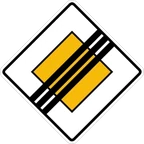
End of priority road
Sign 307
The priority road ends. At the next crossroads, whatever the signs there say applies; without a sign, priority to the right.
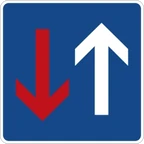
Priority over oncoming traffic
Sign 308
You have priority over oncoming traffic at the narrow section.
Having priority does not mean you may force it. Constant care and mutual consideration still apply (§ 1 StVO).

Town sign
Sign 310
A built-up area begins here. From the sign onwards, the rules for built-up areas apply, such as 50 km/h.
The 50 km/h limit applies from the town sign, not only from the first houses.
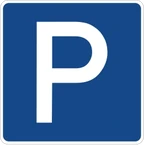
Parking
Sign 314
You may park here. Supplementary plates can specify the parking time, the type of vehicle, a parking ticket or a parking disc.

Start of a traffic-calmed area
Sign 325.1
You drive at walking pace. Pedestrians may use the whole street, and children may play everywhere. Parking only in marked spaces.
Such an area is often called a "play street" in everyday German. When driving out of it, you must behave so that nobody is put at risk (§ 10 StVO).
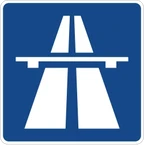
Motorway
Sign 330.1
From here, the rules for motorways apply. Only motor vehicles designed to go faster than 60 km/h may use it.
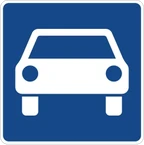
Expressway
Sign 331.1
From here, the rules for expressways apply, with the same limit of more than 60 km/h as on the motorway.
You may only join an expressway at crossroads or junctions.
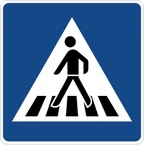
Pedestrian crossing
Sign 350
There is a zebra crossing here. You must let pedestrians who clearly want to cross do so.
You must not overtake at a zebra crossing. Stopping on the crossing and up to 5 metres before it is prohibited.
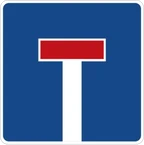
Dead end
Sign 357
The road does not continue for vehicles. A symbol at the top can show that pedestrians or cyclists can get through.
Supplementary plates: what the small sign below means
Supplementary plates are traffic signs too. They show black symbols or text on a white background and are placed directly, usually below, the sign they refer to (§ 39(3) StVO). They can limit a ban to certain times, make it apply only to certain vehicles, announce a distance or allow exceptions, such as "cyclists permitted".

Supplementary plate with distance
Supplementary plates
Shows at what distance the rule of the main sign begins or the hazard follows.
An example that is often overlooked: if a supplementary plate for a wet road is shown below a speed limit, the limit only applies when the road is wet.
Green arrow at traffic lights
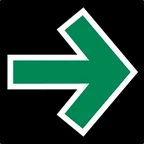
Green arrow sign
under § 37 StVO
After stopping, you may turn right on red, but only from the right-hand lane.
You must rule out any obstruction or danger to others, especially pedestrians and vehicles that have a green light, including cyclists.
Traffic lights take precedence over priority rules and priority signs (§ 37(1) StVO). Priority signs at a junction with traffic lights therefore matter above all when the lights are switched off.
Traffic control devices: beacons, cones and barriers
Barriers, beacons, traffic cones and barrier boards prohibit driving on the area marked in this way and guide traffic past it (Annex 4 StVO). Red warning lights on them mean that the whole carriageway is closed. Otherwise they show a yellow or flashing yellow light.

Guide beacon
Sign 605
Marks roadworks and obstacles. You must not drive on the closed-off area; the beacon guides you past it.
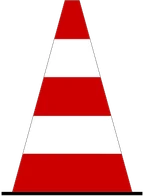
Traffic cone
Sign 610
Temporarily closes off an area and guides traffic past it.
Priority to the right and right of way: how to handle every crossroads
At crossroads and junctions, whoever comes from the right has priority (§ 8(1) StVO). This does not apply if priority is regulated by traffic signs, nor to vehicles coming from a field or forest track onto another road. The order in which you check a crossroads follows from the StVO:
- Police: Signals and instructions from police officers take precedence over all other rules (§ 36 StVO).
- Traffic lights: If the traffic lights are working, they take precedence over priority signs and over priority to the right (§ 37 StVO).
- Signs: "Give way", "Stop", "Priority" and "Priority road" determine who has to wait (§ 8(1) StVO).
- Priority to the right: If none of these regulates the crossroads, whoever comes from the right has priority.
If you have to wait, show it in good time by driving at a moderate speed. You may only continue if you do not endanger or significantly obstruct anyone with priority. If the crossroads is hard to see, you may edge forward carefully until you can see everything (§ 8(2) StVO).
Four situations that are often handled wrongly
- Turning left with priority: Even if you have priority, you must let oncoming traffic pass when turning left (§ 9(3) StVO).
- Roundabout without "Give way": If there is only the roundabout sign at the entry without a "Give way" sign, priority to the right applies. Anyone entering the roundabout comes from the right for the traffic already on it and therefore has priority. Such roundabouts are rare, so look out for the triangle at every entry.
- Driveways and lowered kerbs: Anyone driving onto the road from a property, a traffic-calmed area or across a lowered kerb does not have priority, even from the right, and must rule out any danger to others (§ 10 StVO).
- Car park: In public car parks without signs, priority to the right does not apply if the lanes do not clearly have the character of a road (Federal Court of Justice, judgment of 22 November 2022, VI ZR 344/21). There, mutual consideration is what counts.
In the theory test, questions on priority are among those that carry the most weight. How the test is scored is explained in our guide Theory test. How to learn priority rules and traffic signs step by step is covered in the Theory study plan.
Zip merging: merge at the very end
If one lane ends or is blocked on a road with several lanes in one direction, the zip-merging rule applies (§ 7(4) StVO). Vehicles in the ending lane merge in turn directly before the start of the narrowing: one from the continuing lane, then one from the ending lane. Drivers in the continuing lane must allow this.
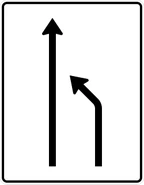
Lane reduction sign
Sign 531
Shows that the number of lanes decreases and one lane ends.

Zip-merging supplementary plate
with sign 531
Shows where the change of lane by zip merging should take place.
A common mistake is to merge as early as possible. The law requires merging directly before the narrowing. You still have to indicate, and you may only change lanes if you do not endanger anyone (§ 7(5) StVO).
Joining the motorway is not zip merging: traffic on the main carriageway has priority there (§ 18(3) StVO), and you merge into a gap.
Learning traffic signs
Learn the signs in groups rather than one by one: first the shapes, then the priority signs, then prohibitions and information signs. Many test questions show a photo of a traffic situation in which you first have to find the decisive sign. In driving school theory lessons, priority and traffic signs are separate topics of the basic syllabus, for example in our Theory timetable. For the practical test, read our guide Tips for the practical test: if you do not come to a complete stop at a stop sign, you will usually fail.
Frequently asked questions about traffic signs
What types of traffic signs are there?
The German Road Traffic Regulations (StVO) distinguish between warning signs, regulatory signs and information signs. Supplementary plates and road markings are traffic signs too. In addition, there are traffic control devices such as beacons, traffic cones and barriers.
What is the difference between "Give way" and "Stop"?
At "Give way" (sign 205) you must wait if traffic with priority is coming, but you do not always have to stop. At "Stop" (sign 206) you must always stop, even if the road is clear.
What does the sign with the yellow diamond mean?
The yellow diamond with a white border is sign 306, priority road. You have priority until a "Give way" sign, a "Stop" sign or the end of the priority road. If the diamond is crossed out, the priority road ends.
When does priority to the right apply?
Priority to the right applies at crossroads and junctions where priority is not regulated by traffic signs, traffic lights or the police. Vehicles coming from a field or forest track are an exception. Anyone coming out of a driveway or across a lowered kerb does not have priority either (§ 10 StVO).
Does priority to the right apply in car parks?
According to a ruling of the Federal Court of Justice (BGH), priority to the right does not apply in public car parks without priority signs if the lanes do not clearly have the character of a road. There, mutual consideration applies: drive slowly and communicate with each other.
How does zip merging work correctly?
If a lane ends or is blocked, you stay in your lane until just before the narrowing. There you merge in turn: one vehicle from the continuing lane, then one from the ending lane. Drivers in the continuing lane must allow this.
Does zip merging also apply when joining the motorway?
No. When you join the motorway, traffic on the main carriageway has priority (§ 18(3) StVO). You have to merge into a gap.
What does the white sign with black diagonal lines mean?
That is sign 282: end of all route-related speed limits and overtaking bans. Speed limits and overtaking bans set earlier end here. After that, the general speed limits apply again, which means 50 km/h in built-up areas.
How long does a no-stopping zone apply?
A stopping ban under sign 283 or 286 applies on the side of the road where the sign stands, up to the next crossroads or junction. Another sign can lift or change it before that. Times shown on a supplementary plate limit the ban to those times.
What applies if traffic lights and signs show different rules?
The traffic lights take precedence. Light signals take precedence over priority rules and priority signs. Signs and instructions given by police officers take precedence even over traffic lights.
Can I park in a traffic-calmed area?
Only in the spaces marked for parking. Getting in and out as well as loading and unloading are also allowed outside these spaces.
What does the green arrow at the traffic lights mean?
The metal sign with a green arrow on a black background to the right of the red light allows you to turn right on red, but only after stopping and only from the right-hand lane. A green arrow lit up in the traffic light is something else: it allows traffic to proceed only in the direction of the arrow.