
Guide · Driving licence eye test
What is tested, how much does the test cost, what visual acuity do you need, and what happens if it is not sufficient?
Short answer: For categories AM, A1, A2, A, B, BE, L and T, you need an official eye test from a recognised eye test centre – usually an optometrist. You have passed it with at least 0.7 in each eye, with or without vision aids. At many opticians the test is free of charge, otherwise it usually costs a few euros. The certificate is valid for two years from the date of issue – you must submit your driving licence application within this time.
An online vision test does not replace the official certificate. An ophthalmological certificate can replace the vision test pursuant to Section 12 paragraph 4 FeV (Driving Licence Ordinance) if it confirms the requirements. For lorry and bus categories, stricter examinations apply from the outset.
Which driving licence category would you like to get?
Select your class. Without JavaScript, all information remains readable.
Car: Class B, B197, B78 and BE
The simple eye test is sufficient: at least 0.7 on the right and 0.7 on the left, with or without vision aids. The value must be achieved in each eye individually - an average of both eyes does not count. B197, B78 and BE do not change anything about this.
Motorcycles: Class A, A1 and A2
Here too, the simple eye test with at least 0.7 in each eye applies, with or without visual aids. You are also allowed to wear glasses or contact lenses when riding a motorcycle.
Categories AM, L and T
The simple eye test with at least 0.7 in each eye also applies to mopeds (AM) as well as agricultural and forestry vehicles (L, T).
HGV and bus: C, C1, CE, C1E, D, D1, DE and D1E
A simple eye test is not sufficient here. A more comprehensive examination of visual acuity is required, including, among other things, a visual acuity of 0.8 in each eye and 1.0 binocularly, as well as tests of the visual field, colour vision, stereoscopic vision and twilight or contrast vision. This examination is also mandatory when renewing these licence categories.
How the eye test works
- Select vision test centre: According to Section 12 Paragraph 2 and Section 67 Paragraph 4 of the Driving Licence Ordinance (FeV), optician businesses are officially recognised vision testing centres. Testing is carried out in accordance with DIN 58220 Part 6, April 2021 edition. Ask beforehand whether it is expressly the official driving licence vision test and whether you need an appointment.
- Take ID and vision aid: The eye test centre has to check your identity – bring your identity card, passport or another identity document with you, along with the glasses or contact lenses you drive with.
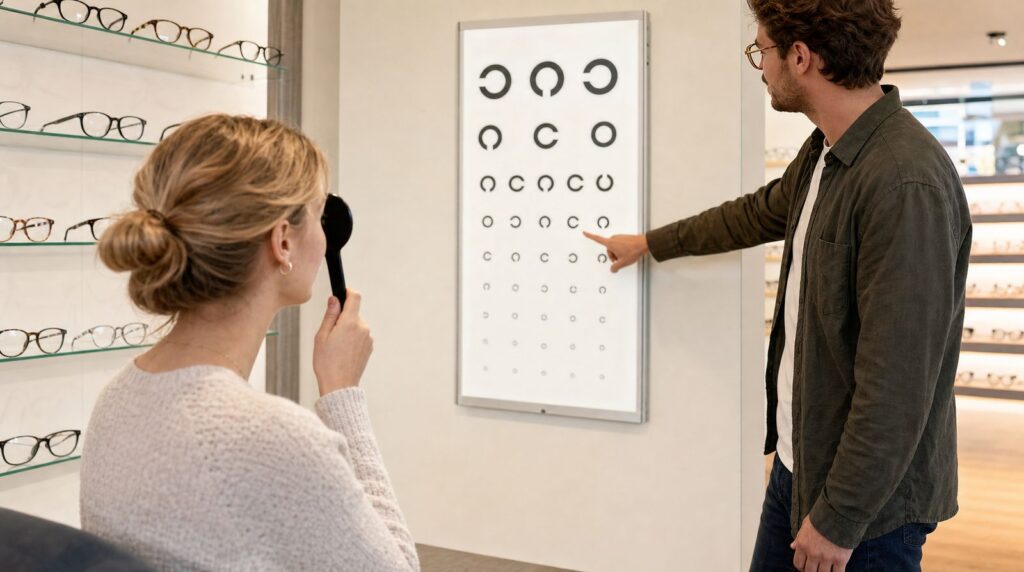
- Reading the eye chart: You recognise visual acuity symbols, usually Landolt rings, and state the direction of the gap. Each eye is tested individually. This usually only takes a few minutes.
- Result: If you achieve at least 0.7 in each eye, you pass the test. If the value is not sufficient, you are allowed to repeat it with visual aids or improved visual aids.
- Check certificate: The eye test certificate states whether you passed and whether it was tested with visual aids. Check your name and date of birth, and keep the original in a safe place.
- Make an application: You submit the certificate along with your driving licence application to the driver licensing authority – no later than two years after issue. Depending on the application, this must be accompanied by proof of first aid and a biometric passport photo.
How much does the driving licence eye test cost?
There is no fixed price by law – every provider sets it themselves. Several major optician chains advertise a free driving licence eye test (as of September 2026, for example Fielmann and Mister Spex). Other opticians usually charge a few euros; €6.43 is frequently mentioned.
| Where | Cost | What you should look out for |
|---|---|---|
| Opticians chain with offer | often free of charge | Check if the official certificate is included |
| Optometrists and dispensing opticians | usually a few euros | Enquire about price beforehand |
| First-aid training provider with vision test and passport photo | included in the package price | Check the accreditation of the vision test centre and the scope of services |
| Ophthalmologist (certificate) | Billing according to the scale of fees for doctors | Only necessary if the eye test is not sufficient or if you want to submit a certificate anyway |
A free glasses check is not automatically the official sight test certificate. Therefore, specifically ask for the driving licence sight test.
Eye test, first aid and passport photo all in one day
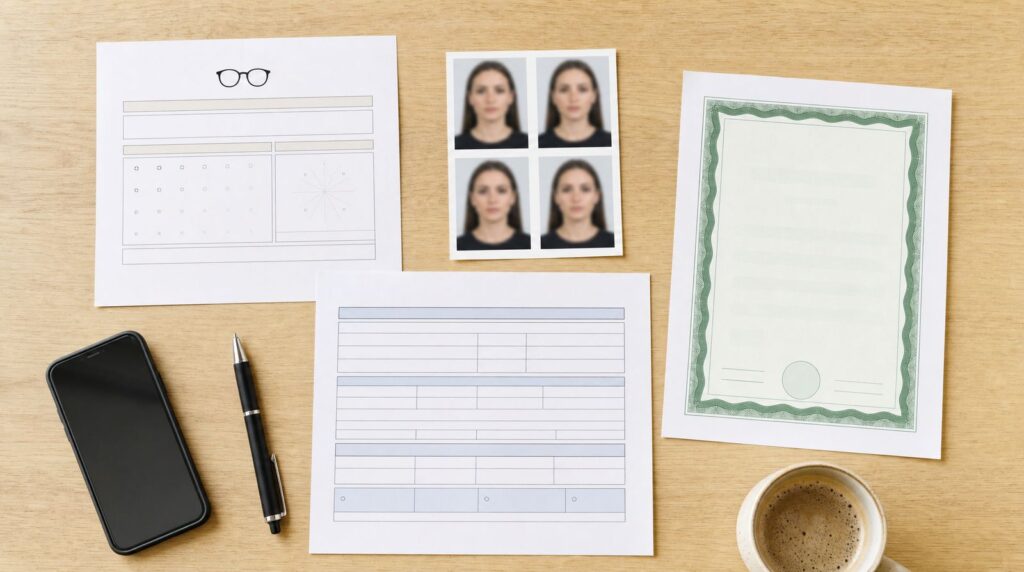
Many first-aid providers offer the course, official eye test and biometric passport photo on the same day. This saves journeys, but is not a legally standardised package. Check recognition, price and whether you can take the certificates with you directly beforehand.
What level of visual acuity is required?
For the basic eye test, the following applies 0.7 in the right eye and 0.7 in the left eye (Appendix 6 Number 1.1 FeV). Colloquially, this is often referred to as „70 percent visual acuity“. Visual acuity describes how sharply you can see – it is not a dioptre value, so it is not the strength of your spectacle lenses.
One eye's vision is getting worse
If one eye fails to reach 0.7, the basic visual acuity test is failed – even if the other eye sees very well. You can repeat it with visual aids or a better-adjusted visual aid. If that is still not enough, an ophthalmological examination follows. For these classes, a minimum of 0.5 with the better eye or binocularly generally applies there; additional visual functions are also tested.
| Simple eye test | Eye examination |
|---|---|
| Standard proof for AM, A1, A2, A, B, BE, L and T | Following a failed eye test or if further examinations are necessary in individual cases |
| Above all, central daytime visual acuity | In addition to, among other things, visual field, twilight and contrast vision, glare sensitivity and double vision |
| vision test certificate | Optometrist's certificate for the authorities |
Glasses, contact lenses and key figures
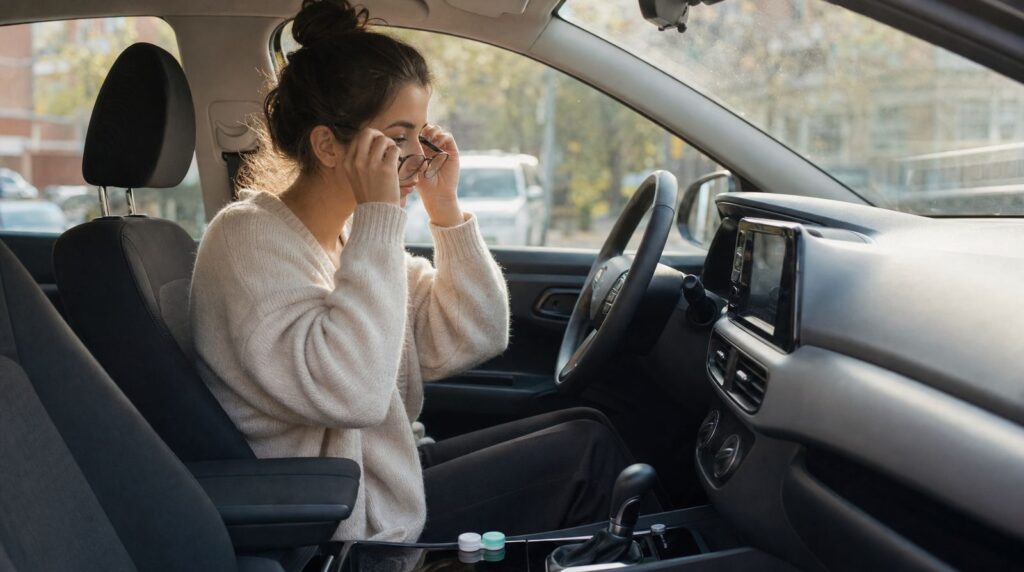
You are allowed to take the eye test wearing glasses or contact lenses. If you only achieve 0.7 with visual aids, the authority will enter a code in your driving licence – for example, 01.01 for glasses, 01.02 for contact lenses or 01.06 for glasses or contact lenses. The authority decides which restriction is entered on the basis of the proof provided.
You must wear your registered visual aid while driving. Anyone driving without it commits a summary offence; as a rule, a fixed penalty notice of €25 is payable.
What happens if you don't pass?
A failed eye test is not the end of your training. Often, a visual impairment just hasn't been properly corrected yet.
- Sort out visual aid: Get your eyesight checked by an optician or ophthalmologist and have your glasses or contact lenses adjusted.
- Retake eye test: Under Section 12 paragraph 2 of the FeV, you are allowed to repeat the test with visual aids or improved visual aids.
- Ophthalmological examination: If it is not enough again, you must undergo an ophthalmological examination in accordance with Section 12, Paragraph 5 of the Driving Licence Ordinance (FeV) (Annex 6, Number 1.2).
- Submit certificate: You submit the ophthalmologist's report to the driving licence authority.
- Decision of the authority: She decides on a case-by-case basis. Conditions or restrictions are also possible, such as driving only in daylight or additional wing mirrors.
Frequently Asked Questions
How much does an eye test for a driving licence cost?
At many opticians, including several major chains, it is free. Otherwise, it usually costs a few pounds – there is no fixed price. Ask beforehand whether the official certificate is included.
How long is the eye test certificate valid?
Two years from issue. Until then, you must have submitted your driving licence application – the certificate must not be more than two years old when you apply (Section 12(7) of the Driving Licence Ordinance (FeV)). If the application is submitted on time, you do not need a new eye test, even if the training takes longer.
Do I have to take the eye test before or after starting driving school?
You can start driving school beforehand. You need the eye test for your driving licence application. The easiest way to get it done early along with the first-aid course and passport photo so the application doesn't have to wait.
May I take the eye test with contact lenses or glasses?
Yes. Take the visual aid with you that you also wear when driving. If you only pass with a visual aid, a code number will be entered.
Can I retake the eye test?
Yes, with a visual aid or improved visual aid. If the value is insufficient again, an ophthalmological examination is necessary.
Do I also need the eye test for category BE?
Yes. For BE, the basic eye test with 0.7 in each eye applies.
Is an online eye test enough?
No. For the application, you need a certificate from an approved eye test centre or an ophthalmological certificate.
Where can I do the eye test?
At an officially recognised vision test centre. Opticians are considered recognised. Some first-aid providers also offer the test.
How much does it cost to drive without prescribed glasses?
Usually a €25 fixed penalty. You must always wear the corrective lenses that are recorded on your driving licence while driving.
Do I need a new eye test for exchanging my driving licence?
Not so during the mandatory exchange for the new photocard driving licence for category B. The new card is valid for 15 years, while the driving licence itself remains valid indefinitely. More on this in the Guide to exchanging your driving licence.
Checklist
Before the test
- Had enough sleep
- Regular glasses or contact lenses prepared
- Allow a few days to get used to new glasses
- Asked for an official eye test and price
Take away
- identity card, passport or other identity document
- Glasses or contact lenses you drive in
After the test
- Name and date of birth checked on the certificate
- Stored safely in original condition
- Application submitted within two years
- In case of failure, consult an optician or ophthalmologist
Read more
Legal basis: Section 12 of the FeV, Section 67 FeV and Appendix 6 FeV. For your specific application, the competent driving licence authority is decisive.